Every Literary Reference in The Life of a Showgirl
Podcast Episode, January 28, 2026
Episode Description
What do Shakespeare, a wooden puppet, a school for dragon riders, and Taylor Swift have in common? Apparently…The Life of a Showgirl.
In this episode of the Swiftly Sung Stories Podcast, we follow Taylor Swift down her literary rabbit hole, unpacking every hidden reference woven into The Life of a Showgirl – from Hamlet to Pinocchio to The Fourth Wing, and everything in between.
If some of the stories in this album feel familiar, it’s because they are, and Taylor is pointing us to them! And if you’ve ever longed for a peek at her bookshelf, this is probably as close as we’re going to get.
Whether you’re a Swiftie or a literature lover, this deep dive into Taylor’s literary universe is for you.But if your to-read pile is already overwhelming, don’t worry – I’ll also include television and film adaptations that are just as great as the books themselves.
✏️In this episode, you’ll learn:
⏺ Which classic fairytales inspire Taylor’s storytelling
⏺ The Elizabeth Taylor biography probably (definitely) inspired the song
⏺ The classic feminist text alluded to in Eldest Daughter, and what it’s about
⏺ Why Taylor is obsessed with the The Great Gatsby
⏺ And much more
Listen to the Episode
Episode Transcript
(Transcript for Podcast version only)
Before the life of a showgirl was even a glimmer, a sequin. In Taylor Swift’s Eye, our girl loved to pepper her songs with literary references. From Aristotle to Dickens, to Fitzgerald, to Frost Shakespeare, to Patti Smith. We know that she’s a voracious reader and writer, and she loves to leave us little Easter eggs that lead to books, poetry plays, and the people who write them.
Her latest album is no different , even though some of her loudest critics would beg to differ. We’re talking about an album whose lead single is the fate of Ophelia. Which refers to Hamlet, but the rest of her literary references in this album are a little bit more subtle. And I bet you didn’t catch most of these ‘ cause she’s been incredibly crafty this time around.
So today, let’s follow the breadcrumbs and go through every single literary reference in the life of showgirl. One song at a time. But don’t worry this isn’t a reading list because if your to read Pile is as tall as mine, you don’t need more suggestions. So I’m gonna summarize each of these texts for you and also suggest some films and TV show adaptations to get all the context without having to buy more books.
Let’s go.
Welcome to swiftly sung Stories where we unpack the Taylor Swift Universe one era album and lyric at a time. Think of it like English class, but it’s all Taylor Swift and none of the boring stuff. I’m Jen, your Swifty English teacher and classes in session, so come on in and meet me in the margins.
hey guys, before we get into the episodes, I just wanna be vulnerable for a second. I’ve had a really hard time doing anything productive these past few weeks, and I feel like I’m just stuck in hopelessness, like. Nothing matters because the world is falling apart. It seems like there’s nothing we can do to stop it.
I was reading about the life of Renee Nicole Goode, who was murdered by an ice agent in Minneapolis and discovered that she was not only a poet, but a prize-winning poet. So I found her prize-winning poem, and it actually really helped pull me out of this depression and gave me the tiniest glimmer of hope.
So I thought maybe it would help you too. As we collectively grieve and try to process what’s happening in America and happening in the world. I think Renee can give us some insight in her writing. So here’s the poem that won her the Academy of American Poets Prize in 2020. I’ve tried to read this poem on TikTok, but it has gotten taken down many times. So, um, to avoid that censorship, I’m just gonna read it for you here. Now, this probably won’t be in the YouTube version, but here it is.
It’s entitled, “On Learning to Dissect Fetal Pigs”. “I want back my rocking chairs, solipsist sunsets, and coastal jungle sounds that are tercets from cicadas and pentameter. From the hairy legs of cockroaches, I’ve donated Bibles to thrift stores. Mash them in plastic trash bags with an acidic Himalayan salt lamp.
The post-baptism Bibles, the ones plucked from street corners, from the meaty hands of zealots, the dumbed down. Easy to read, parasitic kind. Remember more the slick rubber smell of high gloss biology textbook pictures. They burned the hairs inside my nostrils and salt an ink that rubbed off on my palms under clippings of the moon at 2:45 AM I study in repeat: ribosome endoplasmic lactic acid stamen at the IHOP on the corner of powers and Stetson hills.
I repeated and scribbled until it picked its way. And stagnated somewhere. I can’t point to anymore. Maybe my gut, maybe there, in between my pancreas and large intestine is the piddly brook of my soul. It’s the ruler by which I reduce all things now hard edged and splintering from knowledge that used to sit, a cloth against fevered forehead.
Can I let them both be? This fickle faith and this college science that heckles from the back of the classroom. Now, I can’t believe that the Bible and Quran and Bhagavad Gita are sliding long hairs behind my ear, like mom used to and exhaling from their mouths. Make room for wonder. All my understanding dribbles down the chin and onto the chest, and is summarized as: life is merely to ovum and sperm, and where those two meet, and how often and how well and what dies there.”
I love this poem because for me it beautifully describes this sort of. Messy middle that we’re in right now. Renee writes about being stuck between science and faith and.
How you can navigate both when they kind of cancel each other out. Like believing in one means you can’t quite believe in the other. And it so beautifully describes what I’m feeling and maybe what you’re feeling too about being in this limbo between what this country could be, what this world could be, and what it is now, and trying to reconcile the senseless hate and violence with all of the love and the kindness that you know exists in the world.
And trying to figure out how both can exist at the same time. So Renee, thank you for your beautiful words and we will remember you. We’ll remember your spirit and you live on, and thank you for living your life in service of what is good and moral and kind. now back to the episode.
Okay, let’s dive into all of Taylor’s literary references in the life of a showgirl. Taylor kicks off this album with the Fat Ophelia, in which she uses the fate of one of Shakespeare’s most tragic characters as a metaphor for her own journey in love and in life.
She looks back at these past romances where she was driven to insanity and depression and compares it with how she feels now, like she’s been rescued from this tragic fate. So what’s up with Ophelia? What’s the deal with Hamlet and why is she using this literary reference? Ophelia is the tragic character for Hamlet or the tragedy of Hamlet, prince of Denmark, as is its full title.
It was written by Shakespeare somewhere around the year 1600. This is one of his most well-known plays, and it’s inspired centuries of storytelling in every genre. It’s iconic. It’s a classic. If you don’t wanna read a really long play in old English, because nobody does except us. Lit nerds. But I don’t even really wanna read Hamlet again.
Here’s a very quick synopsis. Hamlet is a prince. His father, the king, dies. Hamlet should rightfully become the king, right? Plot twist. His uncle marries his mom and his uncle claims the throne.
Then another plot twist. The ghost of Hamlet’s father appears and tells him that he was murdered by his brother, Hamlet’s uncle and the now King. He’s supposedly the murderer. He says that Hamlet has to avenge his death. So, where does Ophelia come in? I’m so glad you asked. Hamlet is sort of courting Ophelia before all of this death and deception goes down.
She’s also in this court of Regency families, but of course she’s a woman in Elizabethan era. She has no agency. Her life is dictated by all of the men around her, and that is going to determine her fate. Later on,
After the ghost of the dead King appears, Hamlet decides that in order to find out more information about his father’s murder, he needs to pretend to be insane. That way he can act provocatively and agitate the court and hopefully get to the truth. So he starts small, but it begins this chain of dominoes falling over.
He goes to Ophelia and starts acting crazy.
She goes to her dad and says like, dad, Hamlet’s gone absolutely nuts. And her dad replies, well, maybe he’s just crazy in love, but he says You should probably break up with him, like, just to be safe. But what Ophelia’s dad doesn’t tell her is that he’s going to be spying on this breakup that he’s arranged to find out more information.
He’s performing an experiment, but he doesn’t tell his daughter that. He’s like, go return hamlet’s. Things like break up them so we can see what happens, to see if he’s really crazy or if he’s just crazy in love. So both sides are now using Ophelia as a pawn. Hamlet is using her in this insanity plot and her family and the rest of the court is using her to find out what Hamlet knows about the murder.
So she goes to Hamlet to confront him like her dad told her to. And this is where it all falls apart for Ophelia. Hamlet absolutely goes off on her. Get thee to a nunnery is the famous line here where he is basically. Calling her a slag and shaming her forever, believing that he could ever love her.
Everyone watching this is like. Oh, I guess he’s not crazy in love. Like I guess he’s actually crazy. His mom summons him to say, like, what the hell is going on with you? And Ophelia’s father is hiding behind the curtain and he’s eavesdropping. But Hamlet thinks it’s his uncle, the now King, that’s hiding behind the curtain.
So he stabs the person hiding behind the curtain, but it turns out it was Ophelia’s father and not the king And Ophelia’s dad dies. He’s just murdered his girlfriend slash ex-girlfriend’s dad. So now Ophelia has lost her boyfriend and her father in this game where she’s just being used and manipulated and gaslit, and then she loses her mind for real, not pretending like she actually becomes the mad woman.
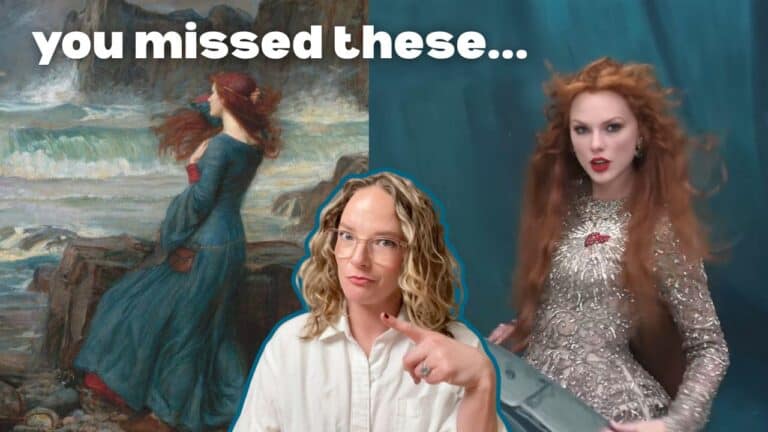
Everyone in her life has gaslit her and she loses the plot. She wanders around singing and speaking in riddles and handing out symbolic flowers and then drowns under a willow tree. Which is imagined by John Everett Millais in that iconic painting that Taylor used in the music video, it’s implied that this is a self-inflicted death, but Shakespeare sort of left it open to interpretation.
The play ends in a very Game of Thrones-esque red wedding where almost everyone dies, including Hamlin and the King. But the important part of the story for Taylor’s lyrics is that the fate of Ophelia is to be driven mad by men. Men who were only using her for their own gain. So when Taylor says, you saved my heart from the fate of Ophelia, she’s saying, you saved me from being lonely and manipulated, or you saved me from being driven mad by all of these men who were just using me.
And if we look back to her asylum metaphors in TTPD, it seems she really was driven mad by men. And one certain man in particular whose name rhymes with Ratty, but it’s not just that line and the title that reference Ophelia, because really this entire song is rewriting Ophelia’s fate and thereby rewriting Taylor’s fate.
So let’s quickly go through the rest. In the second verse, Taylor says, the eldest daughter of a nobleman, Ophelia lived in fantasy, so she’s taking some liberties here. We don’t know for sure the birth order of Ophelia and her siblings, but we can assume that she is the eldest daughter who needs to be married off to a noble family for status.
This line is really though it’s hinting at Ophelia’s lack of agency, like she has no other purpose than to be a wife. So she lives in a fantasy world where she can pretend that she’s free and that she has freedom. She hates it here. So she will go to secret gardens in her mind. But this could also refer to after Ophelia has gotten mad, where she goes around talking in riddles and sings and handing out these crazy flowers .
This could also be the fantasy world that Taylor is talking about is her like delusion after she goes crazy. Then the next lines are, but Love is Cold Bed full of Scorpions. The Venom stole her sanity. This, of course, is referring to Taylor’s romances, but it’s really accurate for Ophelia because Hamlet is the scorpion who steals her sanity metaphorically.
And then there’s, and if you’ve never come for me, I might have drowned in the melancholy. Ophelia in the play. Drowns in the melancholy. She drowns from what we would now call clinical depression. And Taylor references this drowning on the cover of the album, but her version is a near drowning.
Her head is just above water. And the other variation of this line is if you’d never come for me, I might have lingered in purgatory, which could just be referencing this general Catholic ideal of purgatory, which is this kind of waiting area where a soul needs to be cleansed of all sin before it goes to heaven.
But it could also be a reference to Dante’s Divine Comedy. So let’s go on a quick tangent. The Divine Comedy, was written by Dante Allegheri in the 13 hundreds, and it’s a really long allegorical poem that questions what Happens after we die.
It’s divided into three parts, Inferno, purgatory, and Paradise, which narrates this soul’s journey through hell, purgatory in heaven. So the second part of this text, purgatory narrates Dante’s climb up Mount Purgatory. And there are seven stages of purgatory corresponding to the seven deadly sins. And as he moves through each stage, he’s purged of, you know, pride, envy, wrath, so that eventually he can.
Climb the mountain and get to heaven. But the most central idea in this part of the poem and basically in the whole poem is that sin is rooted in love and caused by love. So when Taylor says, I might have lingered in purgatory, she’s saying I might have never made it to a happier place. Like love caused me to reach this really dark place.
But then love brought me out of it. Like, if it wasn’t for you, I might have been sent back to, you know, metaphorical hell or lingered in this limbo. But because of you, I’ve reached metaphorical heaven. So we can see how the story of ophelia’s rescue kind of corresponds to Dante’s journey.
So Taylor’s gone from one medieval text to another, and then when we reached the bridge, tis locked inside my memory. We’re back to Hamlet again. And this time with a very specific reference that nearly quotes Hamlet verbatim In Act one, scene three, we get a scene where Ophelia is talking to her brother Laertes and Laertes warns her not to trust Hamlet because he thinks that something totally shady is going on with that dude.
And he’s right. But as they’re about to part Laertes says, farewell Ophelia. And remember, well what I have said to you. So he’s basically saying like, remember that I warned you about crazy ass Hamlet. And don’t say I told you so if he hurts you and Ophelia replies, ‘tis in my memory locked. And you yourself shall keep the key of it.
So she’s saying, yep, I got it. It’ll be our secret. Like only between us. Only you and I know what we just talked about. So Taylor nearly quotes Ophelia’s dialogue with tis locked inside my memory instead of tis in my memory locked. It means the same thing, that there’s like this special, sacred thing between them but the nature of this shared secret is different for Taylor and her lover than it is for Ophelia and Laertes.
But she’s used this actual line from the text in this really clever way. So really this first song on the album is chock full of Literary References, and there’s so much more to come though not every song on this album is as chockablock as the fate of Ophelia. If you want to consume a form of Hamlet that isn’t reading the original text, you can check out my favorite version.
It’s the 2018 performance in which Andrew Scott Stars as Hamlet and Jessica Brown Finlay from Downton Abbey Stars as Ophelia. It’s a brilliant version of the play, and although they stick to the text, the performances are so brilliant and the visuals are so great that you’ll understand what’s going on even if you don’t understand all the language.
There’s also a billion movies and shows based on Hamlet, including. Disney’s The Lion King. That’s a version of Hamlet and there’s a few more recent adaptations, um, including the book Hamnet by Maggie O’Farrell, of which there’s a brand new film version starring Jesse Buckley and Paul Mescal, which is supposed to be very good.
I’m excited to see it. It’s fictional, but it focuses on Shakespeare and his wife losing their only son Hamnet. And the grief that inspires the writing of this play. So not the story of Hamlet itself, but the story behind the story. Then there’s also the 2018 film Ophelia starring Daisy Ridley, Naomi Watts and Clive Owen, where they really give Ophelia more power as it’s, from her perspective.
It’s not really a stunning film overall, but it does give Ophelia more of a voice, which is very cool.
Moving on to track two, Elizabeth Taylor, in which Taylor writes partially from Liz’s perspective, partially from her own. She’s asking this late great superstar, probably the only person who’s ever attained this level of fame before.
She’s asking. Is it forever or is it just for now? Like, will this crazy life in the spotlight end in tragedy? Or will I get to gracefully step out of public life? Will my lovers stay or will they run away because my life is too big? Now there are no specific literary references in this track that I caught onto, but I was trying to figure out where Taylor could have gotten all of this information about Liz that she includes in the track, the Portofino, the Plaza Athenee, and I found a few options.
The first option is Furious Love, which was spotted a while back on one of Taylor’s Instagram photos of her cat. So. We know that she’s read it. Furious Love focuses specifically on Elizabeth Taylor’s two marriages to Richard Burton. They were married, then divorced, married, then divorced, and this tumultuous romance that really dominated Hollywood for two decades.
It goes into the Portofino honeymoons and the plaza Athenee, and it gives us some insight into this on again, off again, couple. But this book doesn’t focus so much on Elizabeth herself as it does on the two of them together. And in this song, Taylor isn’t talking to Richard Burton. She’s talking to Elizabeth Taylor.
There are a million books and documentaries about Elizabeth Taylor’s life, but my gut feeling is that Taylor read something more recent because a book came out in just the last few years. That’s called Elizabeth Taylor, the Grit and Glamor of an icon written by Kate Anderson Brower. It was released in 2022, so the timeline of reading it and writing this album makes sense and this biographer got incredible access to Liz’s life and letters, and interviewed over 250 of her friends, family, coworkers.
So if you’re looking for a proper account of Liz’s life and her loves, this is the only book that her estate is ever actually authorized. It’s really well done. I’m guessing that this is somewhere on Taylor’s shelf, especially since it came out in just the last few years. I haven’t read all of it yet, but so far I will give you my favorite quote, which is, Elizabeth was one of the most famous celebrities in the world, but alone with her memories, she was like anyone else trying to figure out why fate had brought her here.
There could be no better quote that sums up this song and sums up this album because that’s really what the life of a showgirl is all about. Trying to figure out how she got here, what it means to be the most famous person in the world, and how she can possibly have a private life when the public will always be hungry for more.
And Elizabeth Taylor, the song is really asking this question that this quote hints at, which is. How did I get here and will it last, and what does it cost? This book starts at the beginning of Elizabeth’s life and goes all the way to the end in graphic detail. It is a whopping 512 pages. There’s lots about Italy, the Richard Burton years pause at today, New York and Hollywood.
I haven’t read the whole thing yet, but my guess is that reading this book is likely what inspired her to write Elizabeth Taylor. And in the more recent realm of Elizabeth Taylor content, there is a podcast produced by the House of Taylor Elizabeth Taylor’s estate, and it’s called Elizabeth, the First.
You can find it on Spotify. It’s read by Katie Perry. Love or hate the narrator. It’s a really good podcast, there’s also a 2024 documentary on HBO called Elizabeth Taylor, the Lost Tapes, which tells her story through lost interviews that were only recently discovered.
The trailer for this doc includes this quote, which really hit me. There’s the person that my family knows. And the other Elizabeth Taylor, the commodity one is flesh and blood and one is cellophane. That sounds like a Taylor Swift lyric, doesn’t it? Like with that imagery, the flesh and blood versus cellophane.
So if you wanna hear more about Elizabeth Taylor’s story, those are all good choices that will really give you more information about the real person behind the celebrity spotlight and give you more context as to why Taylor feels this connection with her. Because in so many ways, these two are really cut from the same cloth.
Moving on to literary references in Opalite, one of our favorite bops on the album. So in these lyrics, Taylor uses Opalite, which is a manmade gem stone as her central metaphor for choosing happiness, creating a life that’s fulfilling, and she contrasts this opalite optimism with her previous Onyx.
Night, these long, dark nights of the soul or these previous years of depression and longing. Both Opal and Onyx are very common pieces of imagery and metaphors in poetry, in literature. So there could be a myriad of things, references that she’s making. It would be difficult to really pin down any single one, but book tok seems to think that Taylor’s making a very specific reference here.
So it’s time to tackle the viral question. Were Taylor Swift’s lyrics in open light inspired by the fourth wing.
The Imperion series written by Rebecca Yaros is a YA romantic series that consists of three books so far, the fourth wing, iron flame, and onyx storm. Now, forgive me if I get any of this wrong. I haven’t read it because it’s not my thing, but. My eldest daughter has read all of them, and she filled me in on where she thinks Swifties are drawing these parallels.
So the story follows our protagonist, Violet, as she trains to be a dragon rider. In this world, dragons are magical and humans are not, but they are conduits for the dragon’s magic. So human bonds with a dragon and essentially is given magical powers in this kind of symbiotic relationship. Violet’s magic power when she bonds with her dragon is wielding lightning.
So I think this is the first parallel: the dancing through the lightning strikes. There’s a scene where Violet and her lover Xaden are in a battle against their enemies in the midst of this lightning raining down. So dancing through the lightning strikes, it kind of reminiscent of this particular fight scene.
Xaden’s eyes are constantly referred to as the color of Onyx. So. There’s that, and then there’s also the third book, which is called Onyx Storm. So Sleepless in the Onyx night could be referencing this character’s Xaden, but what about the crux of the song Opalite? This. Man Made gemstone, that’s white or light blue.
Does that have any parallels to the books? Maybe Some of the dragons apparently are described as having the same coloring as opalite, and they can change color and they’re kind of ombre in this range of shades, some of which could look like opalite. Is it a stretch? I don’t know if you’ve read it.
Please chime in in the comments and let me know what you think about this whole debate. Either way, we’ll probably never know for sure if Taylor has indeed read the Empyrean series, but if it gets people reading, I’m all for it. Other than that, I couldn’t find any specific literary or poetic parallels in Opallite.
Opals and Onyx are really common imagery and metaphors, so if you’ve spotted one, I missed sound off in the comments.
Next up is my favorite track father figure, where the student becomes the master, and the master becomes the monster Father figure is narrated by this older, greedy man who meets this young boy and decides to exploit him under the guise of love. He pretends to be this caring father figure in order to get more money and power by manipulating this talented young man.
, but in the end, the narrative flips. The son reclaims his power and kicks the father figure out of his life and out of the story altogether.
This one has several possible literary references because this is a well worn plot line, right? Like we’ve heard this story in so many different forms, in so many different genres. But the first possible reference that I spotted comes from the line, turned your rags into gold. What does that remind you of?
Fairytales automatically reminds you of fairytales, and Taylor has always referenced fairytales since the very beginning of her career, and there could be a few here that she could be referring to.
The first, which I dove into in my full breakdown of Father Figure is Rumpelstiltskin. This is a classic fairytale that has so many different versions, but the popular one, the one that we all most know about is the Brothers Grimm version from 1812. So here’s the story. A poor father has nothing but his beautiful daughter seeking power and prestige.
He brags to the king that his daughter can spin straw into gold. She can’t, of course, but the greedy king is like, cool, like bring her by, see if she can actually do this shit. The father brings his daughter to him and essentially sacrifices his daughter to the king.
And the king locks her in a tower until she can turn all of his draw into gold. If she can’t do it, the king says he’s just gonna kill her. So we’ve got a father figure who only wants money and power just like in the song. And then we’ve got a second father figure, the king who wants the same thing. And they’re both just using this daughter for their own selfish purposes, just like Ophelia is used by her family and by the Royals.
Just saying another little parallel there. So his daughter is locked in the tower with all of this straw, and she is distraught, she’s weeping, like, how is she gonna do this? But then Rumpelstiltskin appears out of nowhere and he’s this little wrinkly elfin trickster, and he says, oh, I can spin that straw into gold, but what are you gonna give me if I do it?
So the daughter is like, well, like I have a necklace. Can I give you my necklace? And he’s like, cool deal. They shake on it. Rumpelstiltskin spins all the straw into gold. She gives him the necklace, and then she’ll be set free by the king. Right? Wrong, the king locks her in a bigger tower with more straw.
Rumpelstiltskin appears again and says, what are you gonna gimme this time? I was like, I, I, you couldn’t have my ring. Like, that’s all I got. He spins the straw and cold. She gives him the ring. The king will be finally satisfied, right, like she’ll finally be free. Wrong again. This time the king says, spin all the straw, and in the morning you will become my wife.
Not quite the freedom she was hoping for, but she’s trapped. This whole process happens all over again. The girl has nothing left to give Rumpelstiltskin. And Rumpelstiltskin says, well then promise me that when you have a child, I get your firstborn. She agrees because she has to like, she figures that that’s a later problem.
Maybe he won’t really take the baby in the morning. The king marries her. She becomes a queen. But later on, after she gives birth to her first child, Rumpelstiltskin brings his wrinkly ass back to collect. Unless she can guess his name, he says he’s gonna take the baby. She tries everything to stop this.
She promises him all the riches in the kingdom. If he’ll just leave the baby alone, but Rumpelstiltskin says no, I would rather have something living than all of the treasures of the world. He wants control. See, theme here In the end, the queen does end up guessing correctly and Rumpelstiltskin throws a fit, saying The devil told you that.
The devil told you that he made a deal with the devil. Sound familiar? And then poof, Rumpelstiltskin disintegrates before her eyes. The end. This is really a story about a power struggle, just like the story of Father Figure, but Taylor says. Rags into gold. Not straw into gold. And even though it’s a metaphor either way, there’s another fairytale that could also apply.
And that’s of course the story of Cinderella. And you all know this one, Cinderella is. Essentially imprisoned by her evil stepmother. She’s dressed in rags, forced to perform manual labor. Then a magical fairy godmother turns her rags into a beautiful gown so she can attend the ball. She has to leave before the clock strikes midnight, or else she’ll transform back into her sooty rags.
And there the ball Prince falls in love with her later on. The shoe fits. They all live happily ever after. A more powerful person. Turned her rags into metaphorical gold. But what both of these fairytales have in common is this central power struggle. The protagonist is used and abused by those who have more power, and in both of these stories, the power balance shifts and the protagonist comes out on top.
So both of these really parallel the story of Father Figure and it’s entirely possible that Taylor had one or both in mind while she was writing the song. What about the rest of the song? This is a well-worn plot that could parallel a bunch of other stories in books. A naive young person gets quote unquote, saved by a rich, powerful father or mother figure who has ulterior motives, but in the end, they’ve created a monster who destroys them.
What does that remind you of? Oh, just the seminal classic Frankenstein by the incomparable Mary Shelley.
In this book, Dr. Victor Frankenstein is obsessed with creating life from death, IE playing God, because he’s power hungry. He creates the creature and tries to control him, but in the end, he’s created a literal monster, something he can’t control. He made a deal with the devil, but turns out the creature’s manhood is bigger and he hunts him down and kills him.
I’m not saying that Taylor was directly inspired by Frankenstein’s father figure, but what I mean is that this trope of a power struggle takes on so many forms, and it’s a classic narrative plot that’s used everywhere. Frankenstein is just one of the most well-known examples, and if you haven’t read Mary Shelley’s Frankenstein, you should.
It’s a short read and it’s incredible. And then there’s also the 2025 Guillermo del Toro film, which is also fantastic, in my opinion. It’s pretty faithful to the book in most areas. But then there’s one more literary reference that Taylor could possibly be making in these lyrics, and it comes towards the end when she says, you’ll be sleeping with the fishes before you know you’re drowning.
It’s very sopranos coded. And what inspired this Sopranos and nearly every other mafia narrative, the Godfather, both the film and the original book, which was written in 1969 by Mardo Puzo. Both the book and the movie follow the saga of the fictional Corleone family, one of New York’s original mafia families as they try to expand and take control and take out their enemies.
There’s infighting and traitors and all of these duplicitous characters, and we follow Vito Corleone as he tries to figure out who he can trust. One could say it’s a modern retelling of Hamlet but one of the most famous lines is Luca Brasi sleeps with the fishes, which Taylor references directly, in father figure, you’ll be sleeping with the fishes before you know you’re droning in the book and in the film, Luca Brasi is literally sleeping with the fishes because they killed him and dumped his body in the East River.
But Taylor’s using it. Here’s a metaphor for like, I’ll disappear you or I’ll make you so insignificant that no one will remember you exist. But it’s not just that one line which references The Godfather, which. The Godfather father figure, but it’s the whole of the final verse, whose portrait’s on the mantle who covered up your scandals mistake, my kindness for weakness and find your card canceled.
These lyrics could be pulled directly from the Godfather because in the end, Vito Corleone portrait is on the mantle, and he covered up all the scandals or killed all of the scandalous people
and canceled the metaphorical cards of his enemies and traitors. Was Taylor watching The Godfather while she was writing showgirl? I don’t know, but I do love this whole mafia coded verse, and how she uses it to describe this protege’s rise to the top.
Moving on to track five, eldest Daughter, the most vulnerable song on the album. And these lyrics describe really what women in general, not just eldest daughters have to do to survive. We put on these fronts, we pretend to be tougher than we are because if we’re seen as weak, we’ll never be taken seriously.
Taylor’s message in this song is basically that when we find the right person, we can let that facade fall and we can be vulnerable and let our guard down, but only when we find safety and feel safe enough to do so. So there’s a small reference in the song that I wanna talk about and a big reference, but both have to do with wolves.
The lyric in the song is every eldest daughter was the first lamb to the slaughter, so we all dressed up as wolves and we looked fire. What this means is that eldest daughters or women in general are the first to be sacrificed. We don’t have as much power as men and eldest daughters have to blaze their own trails in our families.
And in life to get anywhere that we wanna be. So we dress up as wolves. We make ourselves look and act tougher than we are to survive. We put on these facades, the wolf costumes that are built to protect us. The first story these lyrics reminded me of was Little Red Riding Hood, and you all know that Fairytale Little Red Riding Hood is on a journey through the woods to her sickly grandmother’s house.
And along the way, a wolf is stalking her. He asks, where are you going? And she says, oh, to my grandmother’s house. I’m, she’s sick and I’m taking her some supplies. The wolf says, oh, you should pick some flowers for her. She would really like that. So little Red Riding Hood does, and the wolf sneaks ahead to the grandmother’s house, eats her, then dresses up in the grandmother’s clothes to try to trick Little Red Riding Hood.
She reaches the house and the wolf tries to dupe her, and there’s some back and forth. You know, like my with big ears, you have grandma. My big teeth, you have grandma. But in the end, the wolf wins. Now, there are a ton of interpretations for what the story really means, but I’ve always felt like the central allegory is that appearances are deceiving.
Taylor’s take on this is really the same. We dress up as wolves because wolves are dressing up as grandma, like we’re living in a world for of tricksters. So we have to put on these personas, these costumes, to make ourselves look and feel tougher than we are if everyone else is going to deceive us. If we can’t beat him, we had to join him.
So in order to not end up like Little Red Riding Hood, we have to pretend to be the wolf.
So that’s the first story that I noticed in parallels to in Eldest Daughter. And the second is a much heavier text, but also has to do with the wolf.
This is Women Who Run With Wolves by Dr. Clarissa Pinkola Estes. This is a seminal 1992 feminist text, and it actually went viral on TikTok like a few years ago, so it’s kind of been brought back into the public consciousness. If you are a woman and especially an eldest daughter, you should really check this out.
So there’s of course, the Wolf connection. But really this book covers everything that eldest daughter covers and so much more. So Dr. Estes uses the wolf as her. Central metaphor in this text, and the wolf represents the wild woman archetype that like primal part of ourselves that we shouldn’t repress.
And she uses in this book, classic fairytales and folktales to illustrate how we can reclaim that part of ourselves. So this is a really interesting book that’s not really like anything else out there. It’s half dissection of storytelling and it’s half like Jungian psychology. It’s. It’s crazy, but it’s so interesting.
So everything that Taylor covers in this song, being a bad bitch, being a savage, being there for people you love without losing yourself, the facades we put on to protect ourselves, it’s all in this book. And it’s a really good read if you’re into this sort of mishmash of psychology and spirituality.
It’s not just a book about women, it’s about the soul. And who we really are underneath all of these societal expectations, which is exactly what Taylor is talking about in eldest daughter. Has she read it? I don’t know. Probably. But if there is a book mascot for eldest daughter, it’s, it’s this Women Who Run with Wolves.
Moving onto Track six, ruin the friendship which narrates this childhood best friend crush, and the regret that our narrator faces. After he dies, before they could explore a romantic relationship. The central message is that you should ruin the friendship. You should take the chance while you have it, because you never know when it will be too late.
There’s no specific literary references that I could find but there is something really interesting. The story of ruin the Friendship has a lot of parallels to the plot of the summer. I Turned Pretty, which is a book series by Jenny Hahn that was. Uh, recently in the last few years, adapted into a TV series on Amazon Prime, and Swifties will know this well because not only did the author include Taylor’s lyrics as sort of plot points in the novels, she was reportedly listening to Fearless Taylor’s version on repeat while she was writing.
But the Amazon Prime TV show licensed a bunch of Taylor’s music for the show, and that’s really rare. Like Taylor doesn’t just license her music to anyone. Author Jenny Hahn says that she reached out to Taylor with a handwritten letter explaining how much it would mean to her and her fans if they could license some of these songs because they have so much significance to the book and the plot and the characters themselves.
So it’s pretty cool that Taylor did allow these songs to be licensed. I mean, of course she doesn’t just give ’em away for free. They paid for them. But the summer I turned pretty follows Isabella, who is known as belly as she spends summers with two brothers, Conrad and Jeremiah at their beach house one summer, she turns pretty.
She goes through puberty and suddenly has all of the emotions that go along with it. She’s had a crush on Conrad for ages, but will she ruin the friendship? No spoilers. You’ll have to watch it or read it to find out. No one dies in this story as far as I know. But are there some parallels here?
The plot sounds pretty similar,
and we do know that Taylor is tied to the series through song and the author’s use of her lyrics in the text. So go check out the summer. I turned pretty
now for track seven, actually romantic. And I have more of a literary pairing than a literary reference for you. For this one, the song is of course, Taylor’s Vicious Valentine to a person who’s obsessed with her, and the central message is basically like, you must be in love with me because you seem to think about me a whole lot when I think about you.
Never.
That sort of sentiment immediately reminded me of Jane Austen’s Pride and Prejudice, and specifically the attitude that our protagonist Elizabeth Bennett has towards Mr. Darcy, at least throughout the majority of the novel. So here’s the Cliffs notes. Elizabeth Bennett is of Marriageable age in Victorian society, but her family doesn’t have a ton of money, and that makes both her and her sister Jane not very enticing to potential suitors.
A very wealthy neighbor. Mr. Bingley moves into the neighborhood and it’s through him that they meet Mr. Darcy. Bingley is okay. He’s fine, whatever. But Darcy Elizabeth gets the immediate ick. She says quote, he was the proudest, most disagreeable man in the world, and everybody hoped that he would never come there again.
So from the jump, these two are oil and water. Darcy irritates Elizabeth and Elizabeth just confounds him. Like both are incredibly strong-willed and Elizabeth has a ton of cutting lines just like Taylor has in this song. But my absolute favorite is I am no longer surprised at your knowing only six accomplished women.
I’d rather wonder now at your knowing any. Best insult ever. But once they get to know each other better. In this shared social circle, Darcy decides he’s in love with Elizabeth and he wants to marry her. But Elizabeth is still like, dude, get over yourself. And she says to him, from the moment I met you, your arrogance and conceit selfish disdain for the feelings of others made me realize that you were the last man in the world I could ever be prevailed upon to marry.
In other words, it’s actually romantic that you think I would ever marry a person like you. You keep sending me these funny Valentines, but I could never. In the end, of course, they do get together, but for the majority of the book, they’re just talking shit about one another and having this hilarious repartee just trying to insult one another.
So, like I said, a literary pairing rather than a literary reference for this one. And if you want more pride and prejudice, but you don’t wanna read the original Austin book, the Colin Firth version is the Goat, and you need to watch it now.
Next up, we have wishlist spelled with two dollar signs as the s’s. So wishlist is really about material dreams versus emotional dreams. Taylor sees the desires of the wider world. We want that yacht life under chopper blades, we want the bright lights of fame. We want the financial freedom to be able to live off the grid and check out of the real world.
We want all the awards. We want money and power essentially because money and power equal freedom.
But what Taylor wants, since she already has all of those things, is a real partner and to settle down and for the world to leave her alone when she asks to be left alone. So wishlist is really about the American dream, right?
What literary classic has Taylor referenced several times throughout her writing and is also about the American dream and the cost of attaining it. Just the Great Gatsby f Scott Fitzgerald’s 1925 novel that explores this very idea. And this is a side note, but Zelda Fitzgerald maybe, probably wrote a lot of it.
So the real shout out goes to Zelda, who is a badass. And another side note, Zelda is who inspired the name of the video game character Princess Zelda, and she also inspired Witchy Woman written by Don Henley for the Eagles. Her life is a rabbit hole of lore. If you ever need an activity for Saturday afternoon, Zelda Fitzgerald, so the Greg Gatsby, which you were probably forced to read in high school and hated at the time.
Follows. A young man named Nick, he aspires to attain the American dream. He’s training in finance and he goes to live on Long Island and happens to move next door to Jay Gatsby. Jay Gatsby is this larger than life Playboy character who has it all. He’s got this huge gothic mansion, all the money in the world, and he throws these lavish debaucherous parties every weekend.
That is, he seems to have it all except the love of his life. Daisy Buchanan, who is married to someone else, turns out that Daisy is Nick’s cousin and he learns that all of this glitz and glamor put on by Gatsby is just an attempt to win Daisy back every night. Gatsby goes out onto his dock and he stares at the green light across the bay.
That is on Daisy’s dock, which Taylor maybe probably references in happiness, the green light of forgiveness. So Gaby finds out that Nick knows Daisy and he starts using Nick to get to her. And this is also advantageous for Nick because he wants to be in this world of glamorous, rich, and famous living the American dream.
I won’t spoil the rest for you, but let’s say that Nick’s idea of the American dream doesn’t pan out the way he wants and Gatsby’s dreams end rather badly too. It turns out you can have all of the money in the world, but it won’t buy you love and happiness. It sounds a lot like wishlist, right?
I’m not saying that Taylor is directly referencing the Great Gatsby , but she has referenced it several times before.
And this is why we can’t have nice things. She says, feeling so Gatsby that whole year and in happiness, which I also mentioned before. She also includes the famous, beautiful fool line. And don’t blame me, I was once poison ivy, but now I’m your daisy. If you don’t wanna read the novel, you can watch the 2013 Baz Luhrman adaptation where Leonardo DiCaprio plays Gatsby and Carrie Mulligan, married to Taylor’s friend Marcus Mumford in real life, plays Daisy.
And speaking of Daisy, that brings us to our next track. Wood. Wood is Taylor’s naughty and sexy Track nine, where the central metaphor is knocking on wood. She’s using superstitions and double entendres throughout the song to describe how lucky she is in love and in bed.
Wood opens with a line. Daisy’s bare naked. I was distraught. He loves me not, he loves me, not she’s plucking the pedals from a daisy over and over. But each time it ends the same way. The daisy is naked with no pedals, and in that superstitious game, it means that your crush doesn’t love you back. But she’s using Daisy both to reference the flower and to reference the name because she doesn’t say the daisy, she just says.
Daisy, so is she referencing Daisy Buchanan from the Great Gatsby, whom we know? She’s referenced before, maybe because in the novel, Daisy comes to symbolize this unattainable dream, this unattainable love, and that’s what she’s describing in picking the petals here with the previous Great Gatsby parallels in so much of her writing, it definitely intrigues me.
But what about the rest of the song, which uses wood and knocking on wood as a metaphor for. A lot of things and also includes the line wishing on a falling star. What do wood and wishing on a falling star have in common? Pinocchio, of course, the classic fairytale of the Wooden Boy and also the Disney Classic animated film, which includes the song when You Wish Upon a Star.
So here is the TLDR on Pinocchio. If it’s been a while since you’ve seen it or read it. The Adventures of Pinocchio was originally a serialized fantasy story written by Italian Carlo Collodi in 1881. In this story, a puppeteer carves Pinocchio out of wood, and he comes alive and he goes on this series of adventures that teach him about life and humanity before he can finally become a real boy, which has been his lifelong dream.
But there’s this one huge thing that holds him back, and that is he can’t tell a lie or else his nose grows, which we could say is an allegory for being truthful in the text. But for our purposes, in the parallel to Taylor Song, we’re thinking about the wood growing. Now the Disney animated feature takes quite a few liberties with the original story.
Like in the original, Pinocchio kills Jiminy Cricket with a hammer, but the premise is the same. Pinocchio has to learn all of these important lessons before he can become human. It’s, it’s a hero’s journey. It, the animated feature also includes the now famous song When You Wish Upon a Star, which Taylor references in these lyrics, all that bitching, wishing on a falling star.
But Pinocchio isn’t just alluded to in the lyrics because on the New Heights podcast on which Taylor announced the life of Showgirl, there was a Pinocchio figurine in the background. So she’s definitely pointing us to Pinocchio in this track wood. But I think it’s meant to be more humorous than anything.
Like Pinocchio’s nose grows, the redwood tree ain’t hard to see because it’s. Grown larger than life like you get the picture. So she’s not only clever, she’s hilarious. And then when we pair this track side by side with the smallest man who ever lived, who didn’t measure up to any measure of a man, he’s the tallest man who ever lived, who measures very long.
Moving on to canceled, where we don’t just have literary parallels or allusions, we have a very specific literary reference. This satirical track imagines this dark underworld of celebrity cancellation where Taylor has formed this witchy cancel club full of her fellow fallen celebrity friends. This song I have to emphasize is not meant to be taken seriously.
She’s not glad all of her friends are getting canceled and she’s using satire to call out this Hollywood machine that chews up starlets and spits them out. But in the first pre chorus, she says, this line, something wicked this way, comes and that line is taken directly from Shakespeare’s Macbeth. That’s right.
In an album where she already references Shakespeare, there are even more shout outs to the Bard. So what’s up with Macbeth and why would she use this particular line? Let’s do a quick cliff notes on Macbeth, and I’ll tell you all about it. The tragedy of Macbeth tells the story of this Scottish nobleman Macbeth.
Three witches appear to him, just like the ghost of Hamlet’s. Father appears to him and they tell him that he is destined to ascend to the throne. But is it true? Should he trust these witches? No, but he does because he’s already power hungry. And then he hears this promise of destiny from the witches, and he assumes that it’s written in the stars.
He’s going to be the king because the witches told him so. But Macbeth’s three witches, who are also called the weird sisters, are just evil and chaotic, and they love messing with people. They’re feeding into Macbeth’s ambition and delusion because they just. Enjoy messing around in the human world. Is there a parallel here about how we love to build up celebrities?
Just tear them down? Probably most of the plays, most famous lines come directly from the witches who even, they only appear a handful of times. They’re really pivotal to the play because they’re dictating the plot. Kind of like the masked crusaders in this song, who dictate the fate of famous people.
But so many of the witches’ lines in Macbeth are iconic, like double doble, toil and trouble. Fair is foul and foul is fair. And of course, the line that Taylor uses by the pricking of my thumbs, something wicked this way comes in the play. What’s the wicked thing that’s coming? It’s Macbeth himself. He’s on his way to get more prophecies from the witches, but the witches who are also wicked see the wickedness of Macbeth and decide to exploit it.
So why would Taylor use this line? Something wicked this way comes. I think she’s pointing out the nuance of this situation. Like these celebrities who can be oblivious and devious and not totally moral are wicked, just like Macbeth and the internet mob who take one rumor and run with it, and crucify celebrities if they make one misstep, are also wicked, just like the witches.
No one in this scenario is totally innocent or totally evil. So just like in the play where this line is used to make us notice the wickedness of both Macbeth and of the witches, it’s used the same way here because remember, this song is satire not meant to be Taken literally. And she’s using satire because it allows her to say these kinds of things to make these kind of observations, but like from a distance.
The wicked thing that’s coming is both the masked crusaders and the celebrities getting canceled and also the entirety of cancel culture. But there are positive aspects of all of this too, like being held accountable and transparency and yanking the pedestal away from people who don’t deserve it.
There are a lot more parallels to Macbeth in canceled, so go check out my full breakdown episode if you want the full story where I really dive into the witches and all of the intricacies of Taylor’s lyrics.
Moving on to track 11, honey, this is a song in which Taylor tells us about these times in the past where people have used terms of endearment like honey and sweetheart as weapons. They meant these labels as as insults, but with this new love, he can call her honey and sweetheart and lovely, and she knows that he means it in this loving way.
So he’s redefined this language of love for her simply by being sincere. There are no direct literary references I could find here, but it does remind me of another Shakespeare quote. Surprise, surprise, because this album references Shakespeare quite a lot, and it’s a quote from Romeo and Juliet, which of course Taylor referenced in her much earlier song Love Story.
This quote is from the balcony scene where Juliet is talking about Romeo and he’s eavesdropping. Down below in this scene, Juliet says, what’s in a name that which we call a rose by any other word would smell as sweet. So Romeo would, were he not Romeo called Retain that Dear perfection, which he owes without that title. Romeo Do thy name. And for thy name, which is no part of thee, take all myself.
So what Juliet is talking about here is that Romeo is a Montague with whom Her family, the Caplets, are in a blood feud. These two families are mortal enemies, but for, she doesn’t care what Romeo’s name is like, and that’s what she says. A rose is a rose, even if you don’t call it one. Romeo is the one she loves no matter what his surname is.
So why do we let names get in the way? That’s what Juliet is talking about, and Taylor is getting at a similar idea in Honey where she’s always been the person she is, no matter what you call her, but people use these terms like honey and sweetheart in order to cut her down. But this new lover can use these same words and make her feel loved and valued.
So what’s in a name? It’s, it’s really the intention behind the name. She says, you can call me anything you want because I’m the one you want. So the names themselves don’t matter. It’s the meaning behind them, the intention behind them. Just like for Juliet, the name Montague is supposed to conjure this hatred.
But instead it conjures love. So it’s not the name itself, it’s the meaning we attach to it. So not a literary reference for honey, but a interesting parallel to Shakespeare in an album that’s already been quite heavy on the Shakespeare.
Moving on to our final track, the Life of a Showgirl, the title track of the album.
This song tells the story of Showgirl Kitty. Who could be based on Elizabeth Taylor as that was Elizabeth Taylor’s nickname Kitty, as she tries to climb the ladder of fame and fortune, and we see how hard it was for her to get to her position, what she had to sacrifice, what she’s learned, and what she’s learned is this, this glamorous showgirl life is not as fulfilling as it appears.
She tells the story to a protege trying to warn this wannabe showgirl off, trying to make it. But the protege doesn’t listen and has to learn these lessons for herself, and in the end she learns that the cost isn’t worth the price of admission. You have to sacrifice so much to get there and to stay there that you’ll have very little of yourself when all is said and done.
There’s a lot of stories that follow this type of plot line. There’s Barbara Streisand’s, uh, 1968 film. Funny Girl. There’s all the different versions of A Star is Born. Carrie Fisher’s, postcards from the Edge, and the film also adapted with Meryl Streep.
There’s too many like that we could recount here. It’s a well-worn narrative and we’re endlessly fascinated by it, right? Like how people succeed and what it takes to get there. But a more recent book that this song really reminded me of is The Seven Husbands of Evelyn Hugo, written by Taylor Jenkins Reid, which was published in 2017.
It was hugely popular and made it onto a ton of bestseller lists, and you’ve probably seen it even if you haven’t read it. So here’s the plot that mimics the life of Showgirl fairly closely. Celebrity actress Evelyn Hugo is telling her life story to a biographer and she recounts her aspirations to be a star and everything it took to get there.
Here’s a hint without spoilers. Each of her seven husbands were used basically to climb up this ladder of success in show business. But as her life is coming to an end, she’s looking back and she’s wondering if it was all worth it, and she’s counting everything that it cost her. Sound familiar, just like the plot of life of a showgirl, but it also sounds a lot like Elizabeth Taylor’s life
though the OG Showgirl Kitty seemed to marry for love and not for advantage, but in both Taylor’s song and in this novel, we have an established showgirl recounting the hard knocks of the industry and the personal toll that it takes. Like you can’t have a happy personal life and a thriving professional life in showbiz is really what both of these stories are telling us.
We can see a ton of parallels between Kitty and Evelyn Hugo, but. Here’s where it gets a little meta. So go down this rabbit hole with me real quick. We’re about to talk about a story within a story. because in the book, the Seven Husbands of Evelyn Hugo, which is soon to be ad adopted into a Netflix movie apparently.
If you wanna wait for the screen version, our protagonist Evelyn Stars, in an adaptation of Anna Karenina, that classic novel by Leo Tolstoy. Follows two parallel stories. There’s protagonist Anna who wants a life of love and passion and freedom and feels suppressed by her social standing and just is always wanting more.
And then there’s Kitty. Yes, there is a character called Kitty in Anna Corina. Her full name is Princess Ekaterina So she thinks she wants this passionate life too, of, she always wants more, but then she learns a hard lesson from Anna that if she tries to live her life that way, she’ll only end up heartbroken.
So she goes the other direction and she finds peace and happiness instead of passion and intensity. The character of Kitty in Anna Karenina is used to show the other direction that she could have gone. And actress Evelyn Hugo plays the titular role of Anna Karenina and the author is purposefully using Annakarina.
Like she could have picked, uh, any movie for her protagonist to star in. But she’s using this purposefully to tell Evelyn’s story because it parallels this journey to success through marriage and foreshadows that it won’t end happily ever after, just like it doesn’t end happily ever after for Anna. So we’ve got a few literary connections here.
The seven husbands of Evelyn, Hugo, Anna Karenina, they’re all revolving around this idea of choosing your fate and what will and won’t lead to fulfillment. And that’s really what Taylor is questioning in both the song and in this whole album is, is it worth it? What has it cost her? And will she ever be able to have her cake and eat it too?
Can she have this celebrity life while maintaining a happy personal private life? And she’s also asking like, how long will this last? Like, will I get canceled again or can I keep up this level of success? Like.
Do I get to be both the showgirl and the girl, or will the show always get in the way of the girl?
That is all the literary references I could find in this album. There’s been a lot, but if you have any more, please let me know in the comments. what I would give to have a peek at Taylor’s to read pile.
Because we know that what she reads and what she consumes really informs her songwriting. I would love to be one step ahead and maybe be able to predict what comes next. Thank you so much for joining me on this deep dive of the life of Showgirl and all of Taylor’s literary references or literary parallels, and let me know in the comments what you think I missed.
Hopefully I didn’t miss any obvious ones, but with ADHD and the memory size of a walnut, it’s always possibility. Are there any books or films or TV shows or plays that any of these songs remind you of? Like either on plot or on characters or on vibes? Let me know if you found this insightful, you’re gonna love everything that’s coming up on this podcast. I’ve got so many more Taylor Swift deep dives ahead, so make sure to like and subscribe wherever you are seeing or hearing this.
If you’re listening on your favorite podcast app, go on over and check out my YouTube channel. And if you are watching this on YouTube, you can also find me wherever you get your podcasts. All of this should be ad free. I don’t make any money from this yet. Hopefully I can make my money back somehow, but please share with all of the swifties in your life.
And the English majors in your life, all the readers in your life. Thank you so much for being here and taking a break from the very heavy, real world for a short while. I really appreciate you spending your time with me, and I’ll see you next time.
That’s it for this chapter of Swiftly Sung Stories. If you enjoyed this deep dive, please don’t forget to follow, subscribe, or leave a review. It helps other Swifties find their way here. I’m Jen and I had a marvelous time reading everything with you. See you next time.
More Podcast Episodes
The Life of a Showgirl Deep Dive (Title Track)
The Life of a Showgirl Album & Era Deep Dive
The End of an Era Episodes 1-2 Recap: Magic & Madness
The End of an Era Episodes 3-4 Recap: Kismet & Karma
The End of an Era Episode 5 Recap: Marjorie & The Mastermind