
Taylor Swift’s “Babylon”: Lyrics Meaning, Literary Analysis & Themes
What does “Babylon” mean?
Taylor Swift’s track narrates the story of a man who takes everything in his life for granted. He runs wild, cheats on his wife, and ignores his son. He thinks the grass is always greener somewhere else.
The central metaphor of “Babylon” – the ancient, mythic city that famously crumbled – represents the fleeting beauty that he’s missing.
Using her classic narrative storytelling style, Swift shows us what we miss if we forget to live in the moment and appreciate what we have.
Read on for a line by line analysis of Taylor’s layered and intricate lyrics.

- Title: Babylon
- Track: 16, The Life of a Showgirl: The Encore
- Written By: Taylor Swift, Max Martin & Shellback
- Pen: Fountain
What is Babylon About?
Babylon falls into the category of Taylor’s immersive narrative storytelling songs, similar to All Too Well [10-Minute Version], The Last Great American Dynasty, Father Figure, The Bolter, and more. In these tales, she spins a full narrative from beginning to end, which feels more like a short story than a pop song.
Babylon is a classic morality tale (a parable), where Taylor warns us what will happen if you don’t appreciate what’s right in front of you.
She uses the ancient Mesopotamian city as her central metaphor to represent this greed and gluttony, but Babylon is so much more than an ancient city that crumbled to the ground.
It was the largest city in the world in its time, and known for its ancient wonders, including the mythic Hanging Gardens of Babylon (which Taylor references in cowboy like me). In this way, Babylon represents the pinnacle of “having it all”: beauty, wealth, prosperity.
But in mythology, Babylon fell and the city crumbled due to gluttony and greed. In religious texts, Babylon comes to symbolize what happens when you don’t have your priorities straight. So Taylor’s metaphor here is two-pronged: paradise vs. purgatory.
In pop culture, Babylon is shorthand for something that was once great that rises then falls, or something so epic, so mythic, that we can’t believe that it’s real.
In her narrative, she’s both telling this protagonist that his life IS Babylon (wondrous, beautiful), and also that it COULD BE Babylon (impermanent, falliable) if he doesn’t have gratitude for the things that really matter.
Who is Babylon About?
Taylor hasn’t explicitly revealed who – or what – may have inspired Babylon. As she revealed in her New York Times interview, she’s inspired by anything and everything: books, movies, music, words, friends, et al.
What’s most interesting to me about this track is that it gives us a new ending to The Life of a Showgirl. Previously, the title track was our closing message, saying essentially, ‘this life is not all its cracked up to be, and the life of a showgirl is a life full of pain and pitfalls.’ But Babylon ends this album on a more optimistic note.
Given that Taylor likes to build bridges between albums (like the lyrics that link Hits Different and Fortnight), I’m anxious to see what could be in store for TS13. With this new closing track, we now have a new trajectory that focuses on gratitude, reflection, appreciation, and living in the moment.
Before, the focus was on the cutthroat industry and all the pain it caused. Could Babylon symbolize her new outlook on love and life that will carry into her most anticipated album of her career? Stay tuned.
Babylon Lyrics Meaning: Line by Line
Let’s go through Taylor’s Babylon lyrics and see what we can learn. As a former English teacher, I’ll explain her techniques, as well as point out things you may have missed.
Verse 1: Gambling With Your Life
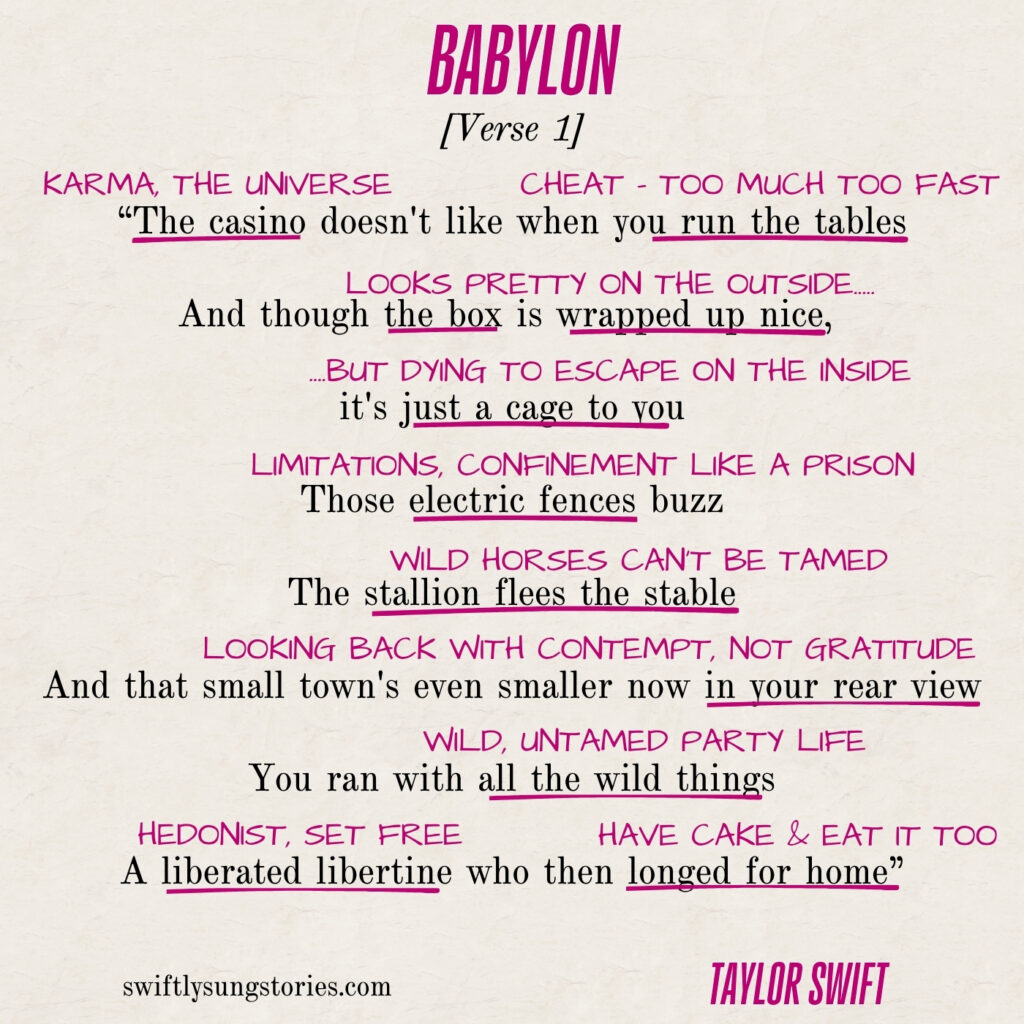
“The casino doesn’t like when you run the tables,” she begins the first verse. She’s dropping us into the middle of a metaphor, where “the casino” is not a casino at all.
To “run the tables” means to be on a hot gambling streak – either by cheating or otherwise – where you win too much too fast. The casino – which in this case represents life, or the universe, or karma – doesn’t like when you get to have it all in an instant.
She’s setting up the themes of greed and selfishness that will continue throughout the lyrics.
“And though the box is wrapped up nice,” she continues, “it’s just a cage to you.” Now we’re in another metaphor for life. It may look pretty on the outside, with all the trappings of a perfect life, but this character (“you”) just feels trapped by it. The box represents two things: pretty packaging (looking like you have it all), and being caged in.
So already we get the sense of what kind of character our protagonist is. He’s selfish, and can’t see what’s right in front of his face.
“Those electric fences buzz,” she goes on, “The stallion flees the stable.” Similar to the box which feels like a cage, he’s surrounded by metaphorical electric fences. He feels trapped in this life that he’s built, and the buzz is the alarm going off in his head: his desire to run away from it all.
The “stallion” – him – gets spooked. And what do stallions do when spooked? They run away.
But the stallion metaphor is a loaded one, stemming from the saying “you can’t tame a wild horse,” meaning you can’t make someone be something that they’re not. Then there’s also the saying, “wild horses couldn’t drag me,” which means you can’t force me to do this thing I really don’t want to do.
So while on the surface the stallion fleeing the stable means he’s now running wild, she’s also subtly pointing out that no one forced him to run. And while it might just be in his nature, he’s also making the choice to run away from the life that he’s built.
“And that small town’s even smaller now in your rear view,” she goes on. As he looks back on his past, he’s looking back with contempt, not gratitude. The town looks “smaller”, meaning he thinks of his past as insignificant or unimportant.
“You ran with all the wild things,” she continues, describing his wild, untamed party life, “A liberated libertine who then longed for home.”
A “libertine” is a person – usually a man – who sleeps around. So to be a “liberated libertine” means he’s been released or freed (from that cage or small town), and he’s now free to do what he pleases with whom he pleases. She’s calling him a slut, essentially.
But what happens after he runs wild, living his best party life? He “then longed for home.” She’s describing a man who wants to have his cake and eat it, too. This will become important when this character finally settles down and makes his own family unit: he’ll still want it both ways.
So in this first verse, she’s given us a huge amount of character building, and as she moves the plot forward for this questionable character, things are not going to work out the way he hoped.
Pre-Chorus/Chorus 1: Life is a Song
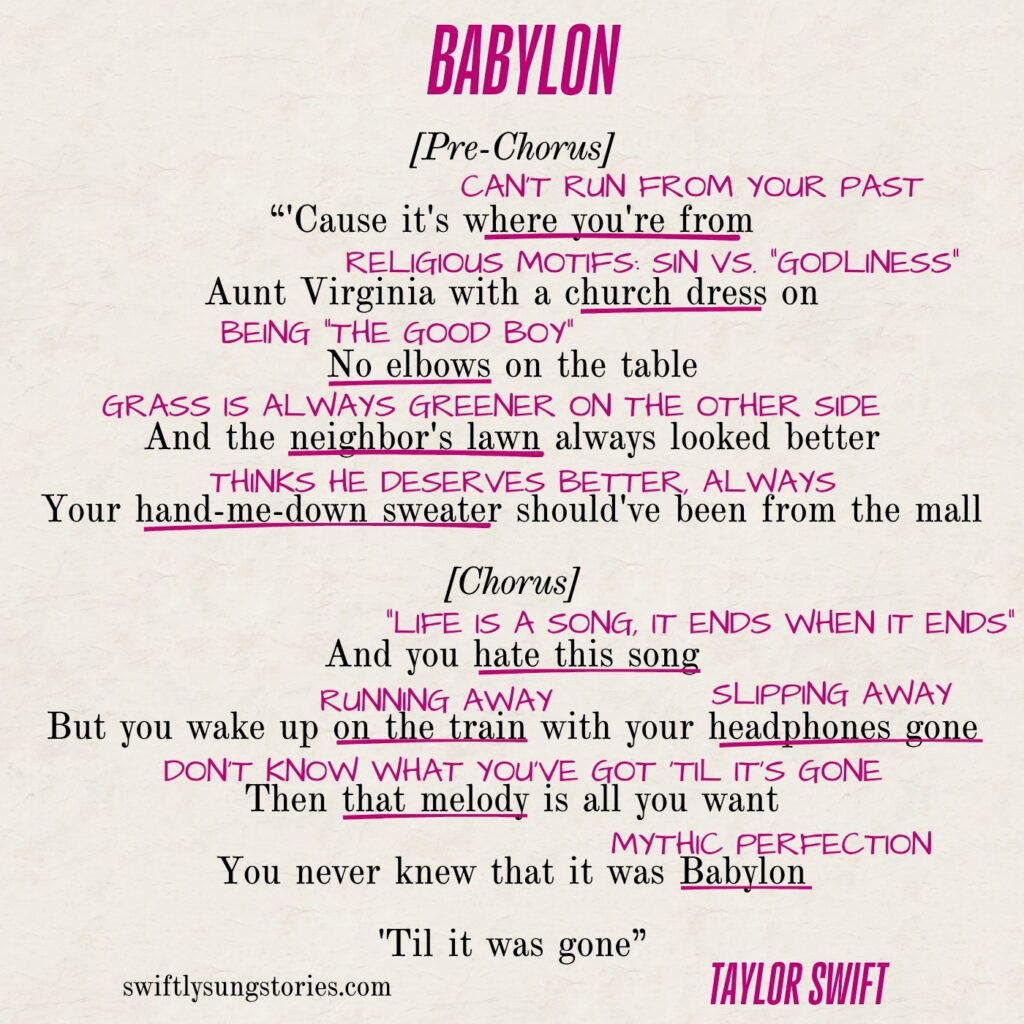
Why does he “long for home”? “Cause it’s where you’re from,” she begins in the first pre-chorus. You can’t run from your past, and as hard as he’s tried to put it in his rearview, he still longs to go back.
He then gets lost in his nostalgic memories of home: “Aunt Virginia with a church dress on.” He’s recalling a memory, but for Taylor, this serves to pull in her religious motifs of the track. She’s playing with the themes of sin vs. “godliness”, which will grow deeper when she brings in the central metaphor of Babylon.
“No elbows on the table,” he remembers from his childhood. This is interesting, because it seems he was raised in a house where manners mattered, and he had to be the “good boy” who went to church on Sundays. But now that he runs wild, he hasn’t learned from his past. This is what will come back to bite him: he gets lost in memories, but doesn’t seem to retain any of the lessons of his previous experiences.
“And the neighbor’s lawn always looked better,” she continues, telling us what he used to think as a kid. He was the kind of person who thought the grass was always greener on the other side.
“Your hand-me-down sweater should’ve been from the mall,” Taylor describes his inner monologue of jealousy and contempt. This is the mindset that will carry him into adulthood: I deserve better. I will never settle for less.
Then in the first chorus, Taylor drops us into another kind of metaphor: “And you hate this song,
but you wake up on the train with your headphones gone, then that melody is all you want.”
So what is “this song”, and what does it represent? There’s a clue in another track from Showgirl: “life is a song, it ends when it ends” from Opalite.
“This song,” that he hates but longs for after his headphones are stolen, is his life. He hates the way he’s living because he can’t live in the moment and appreciate his life. But once it’s gone, he just wants it back.
The train is symbolic, too, as he’s running away yet again. And what happens when he runs away? He loses his anchor to home – “this song” – and once it’s gone, it’s all he longs for. The things that are important are slipping away because of his carelessness, but he can’t see it.
Like Joni Mitchell says, “you don’t know what you’ve got ‘til it’s gone.” And after it’s gone, “Then that melody is all you want.” As soon as it’s gone, he misses it. But did he even appreciate it, or notice it, while he had it? Was he even listening?
“You never knew that it was Babylon,” she says, closing out the first chorus with, “’Til it was gone.” She pulls in her song title and central metaphor for the first time, so this is important.
But what is Babylon? It’s a loaded metaphor for sure, so let’s break it down into smaller pieces.
Babylon was a massive, ancient Mesopotamian city that famously fell. So that’s part of the metaphor: something that was once big and important suddenly ceasing to exist.
But the mythology surrounding Babylon is greater than the physical history. In religious texts, Babylon – and the fall of Babylon – symbolizes man’s hedonism. The pursuit of sin instead of “godliness.” So that’s the other portion of this metaphor: our protagonist is sleeping around, not appreciating what he has, and generally living a hard and fast life with no regard for anyone else.
But this isn’t the first time Taylor has mentioned Babylon in her lyrics, as she also pulled in this simile in cowboy like me: “now you hang from my lips like the Gardens of Babylon.” The Hanging Gardens of Babylon were a mythic ancient wonder of the world, supposedly one of the most beautiful, magical places to ever exist. But we don’t know if they actually existed or not: we have no archeological proof.
So here’s the third prong of the Babylon metaphor, and the general vibe that Taylor is going for (in my opinion). Babylon is something so great, so majestic, so magical, that it’s criminal that he’s missing it.
It’s right in front of his face – this life that he gets to live – but he can’t see it, he can’t hear the “song” of his life, until it disappears.
Verse 2: Watching the Clock
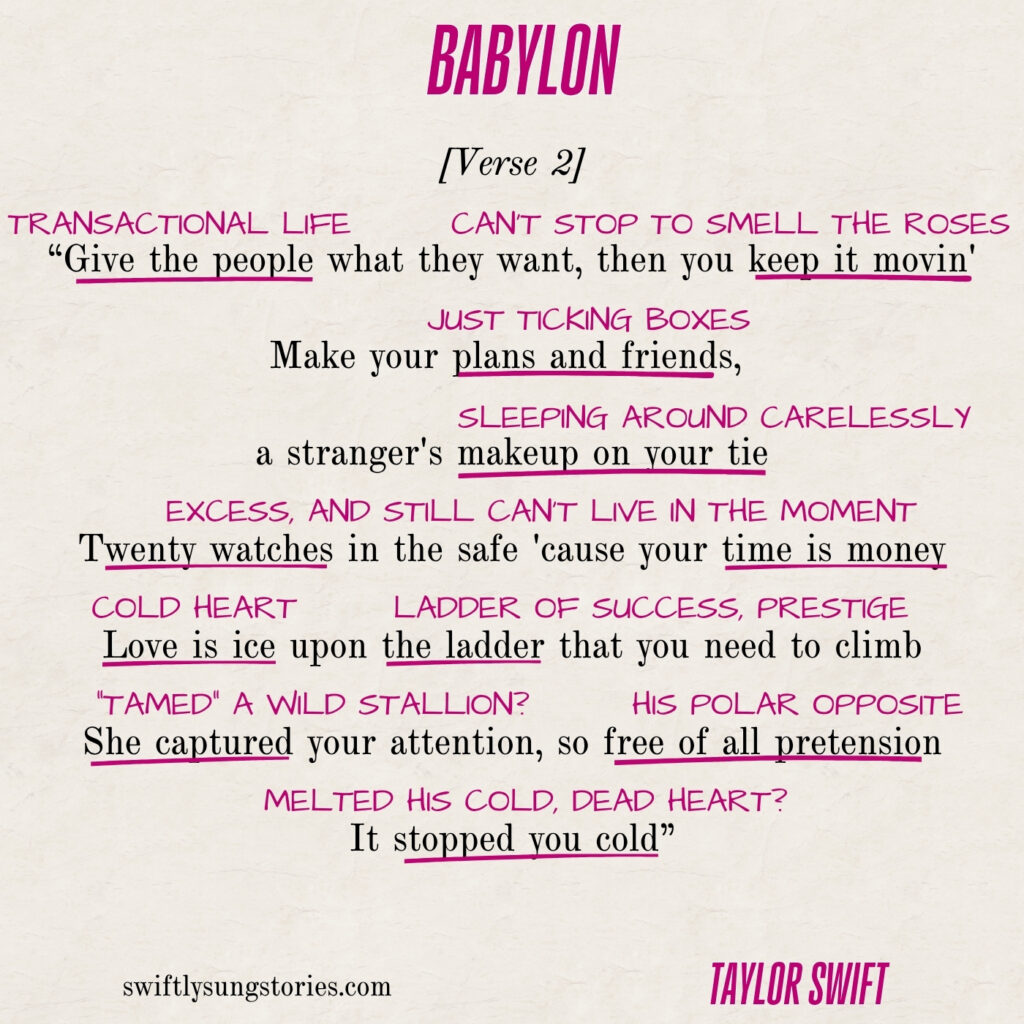
“Give the people what they want, then you keep it movin’,” Taylor begins the second verse. We’re progressing forward in time and space, watching this character move through his life. But he seems automated, only living to tick boxes.
He lives transactionally – giving “the people what they want” – and then moves onto the next order fulfillment. He keeps going, like an assembly line, never stopping to smell the roses.
“Make your plans and friends,” she continues, “a stranger’s makeup on your tie.” He’s doing the things he’s supposed to do – or the things he thinks he’s supposed to do – but not enjoying any of it.
He’s also careless, with “a stranger’s makeup on your tie.” He’s sleeping around with strangers, using sex as temporary pleasure instead of emotional connection.
He has, “Twenty watches in the safe ’cause your time is money.” He’s gluttonous and greedy – owning twenty watches – but he still can’t spend his time wisely (the ultimate irony). He has all the tools and the privileges of a good life, but he still can’t live in the moment.
“Love is ice upon the ladder that you need to climb,” she says, describing his climb to the top of the social ladder. Like in Patient Zero, he’s on a “free solo social climb.” He sees love – emotional connection – as something that can just make him slip and fall. It complicates his ambitions instead of being his ambition. But this metaphor also describes his heart – it’s icy cold.
Then something changes: “She captured your attention, so free of all pretension, it stopped you cold”. He noticed her – this potential love interest – because she was so different from him. He’s quintessentially pretentious, and she is not. Maybe opposites attract, but in the long run, it doesn’t make for a strong magnetic bond.
Taylor’s language here is intentional, though, using “captured your attention” instead of “got your attention.” She’s pulling back in the language of the previous verse, where he felt “caged” and “flees the stables”. This is foreboding: this romance won’t end well.
“It stopped you cold” is interesting, because he can never stop. He can never notice what is right in front of his face. So for him to actually pause and notice isn’t a small thing. But will it work out?
Probably not.
Pre-Chorus/Chorus 2: Afraid to Commit
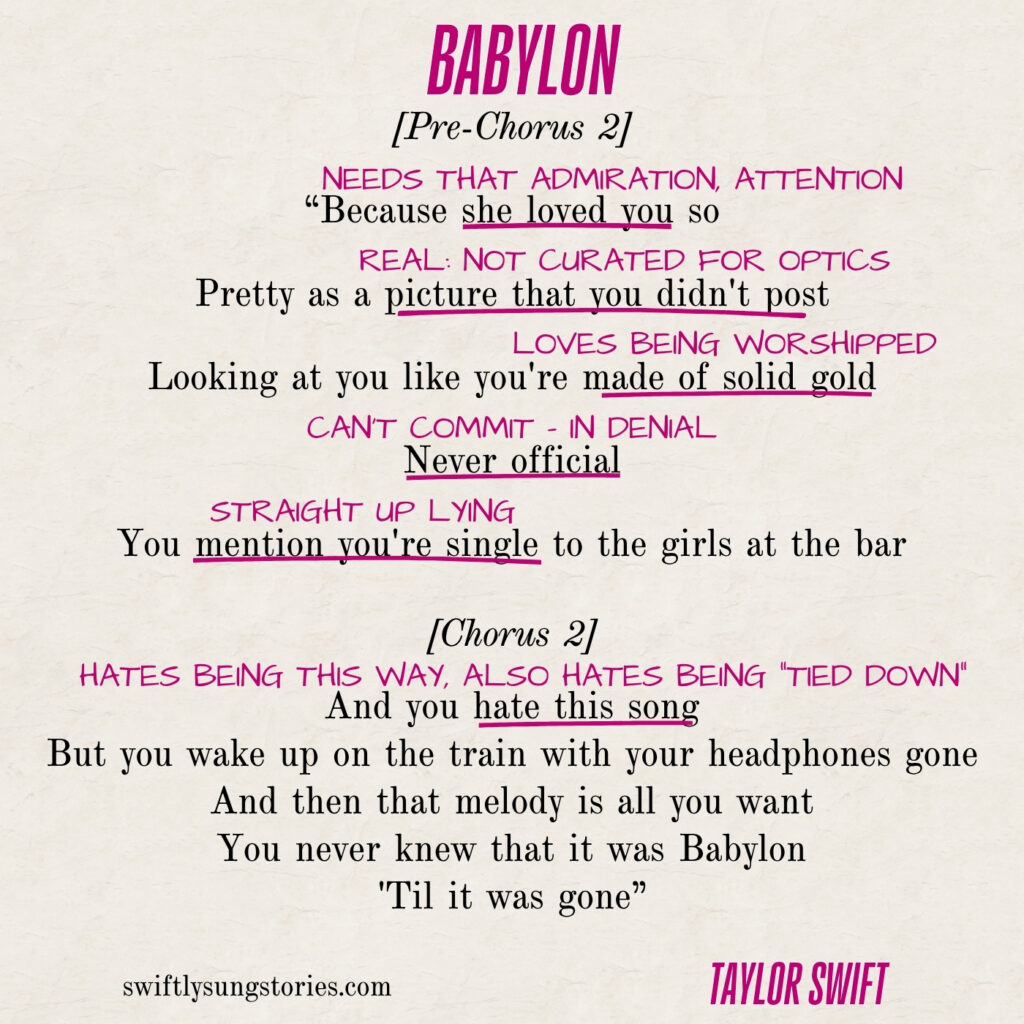
Why did this new person “stop you cold?” “Because she loved you so,” she continues in the second pre-chorus. She either started to warm his cold, cold heart, or he so desperately needed that validation and attention that he grabbed on tight.
She, and this romance, are “Pretty as a picture that you didn’t post.” This love isn’t curated for optics – it’s natural, and it’s real. We’re getting hints that this could be the thing that lifts him out of his shallow existence.
And now, she’s “Looking at you like you’re made of solid gold.” This tells us two things: one, she really loves him and admires him. And two, he’s getting exactly the kind of admiration and attention he’s always craved. But he still can’t commit. He still has one foot out the door, always.
For him, it’s “Never official, you mention you’re single to the girls at the bar.” He has the thing that he’s wanted right in front of him, but he turns his back at every chance. Plus, he’s a liar and a cheater. So now we learn that this love didn’t actually change him at all. Is he capable of changing?
“And you hate this song,” she continues in the second chorus. She flipped the lyrics from “love” to “hate” in this song metaphor, and will continue to do so throughout the lyrics.
Here, it likely means that he hates this shallow life that he’s living, or maybe he hates that he can’t commit to this woman who really loves him and could make his life better.
But this switching between “love” and “hate” illustrates his oscillating between making good choices and bad. He gets on the right track, then derails himself. He misses the past, then he despises the past. He loves his partner, then cheats on his partner. He just can’t sit still; he can’t see where he’s gone wrong. Every time he tries to course-correct, he gets further and further away from the trail.
The rest of the chorus repeats word for word, and as we move into the bridge, our narrator has a blunt and direct message for him.
Bridge: Open Your Eyes
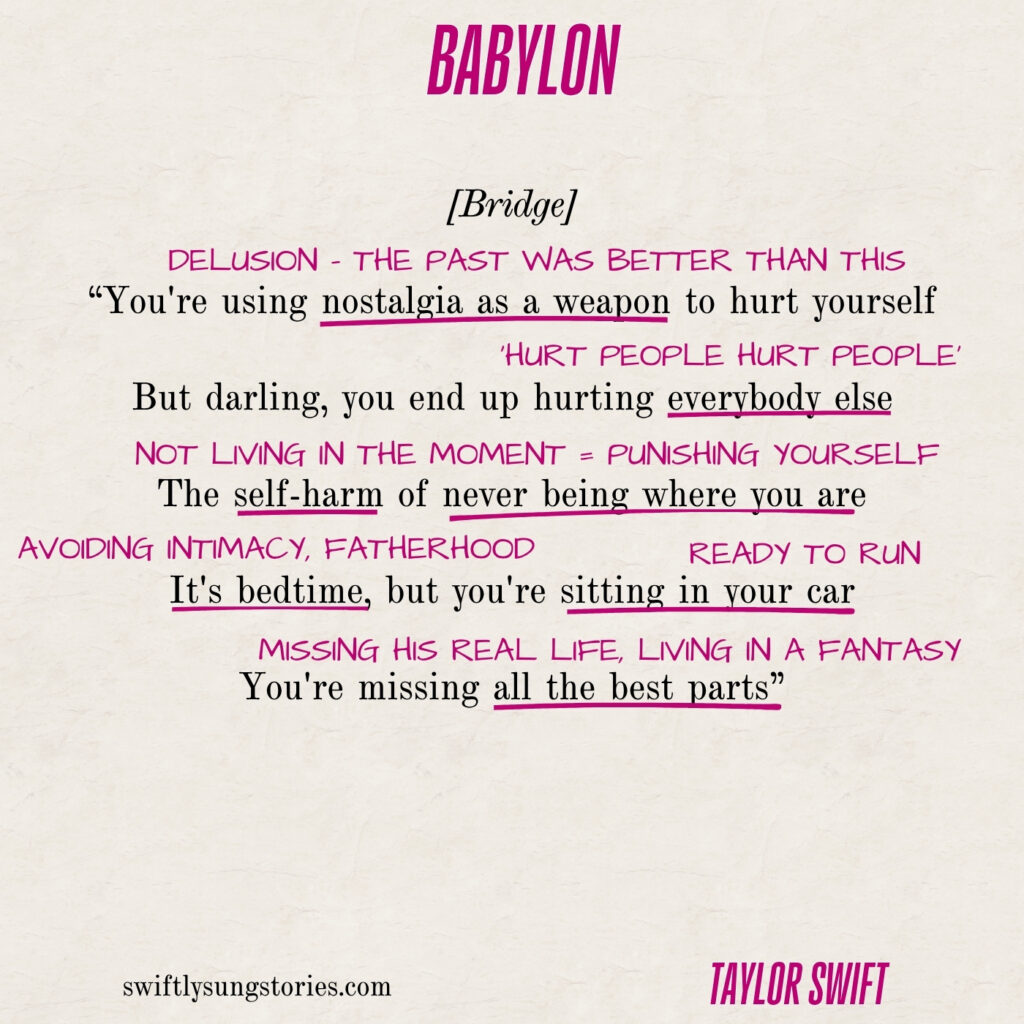
She begins the bridge with this direct accusation: “You’re using nostalgia as a weapon to hurt yourself.”
He’s living in the past, or anywhere other than here, and he can’t see that it’s only making it worse. The “weapon” is the idea that the past was better, or this person was better, or this job was better, or any of the would’ve, could’ve, should’ves.
“But darling, you end up hurting everybody else,” she observes. When you can’t live in the moment, and live in a daydream, you affect everyone else who lives in the real world. But it’s not just nostalgia that’s the weapon, it’s the idea that he always deserves better. That’s incredibly hurtful to the people in your life who will always feel like second best.
Then Taylor pulls in the most powerful line of the whole song: “The self-harm of never being where you are.” You are self-harming, she says, by never living in the moment. You’re missing it, you’re letting life pass you by, if you don’t open your eyes and live in the now.
It’s not just daydreaming, it’s not just obliviousness, it’s not just selfishness. It’s actually self-punishment. You’re self-sabotaging the rest of your life if you can’t start actively living your life.
“It’s bedtime, but you’re sitting in your car,” she says, closing out the bridge with, “You’re missing all the best parts.”
Bedtime is an intimate moment that he’s missing out on, either putting his children to bed, or going to bed with his partner. Instead of being with them, he’s in his car, ready to run away again.
And here’s where we see what he’s really doing in all of this running around wild: he’s avoiding intimacy. He’s scared of being known, or being seen. He’s scared of being vulnerable. And that’s why he runs away.
And while bedtime might seem like a small thing, it’s the small things that make up a life well lived. It’s “all the best parts” that will slip away, faster than those stolen headphones on the train, if you don’t wake up and take action.
Pre-Chorus/Chorus 3: Here, But Gone
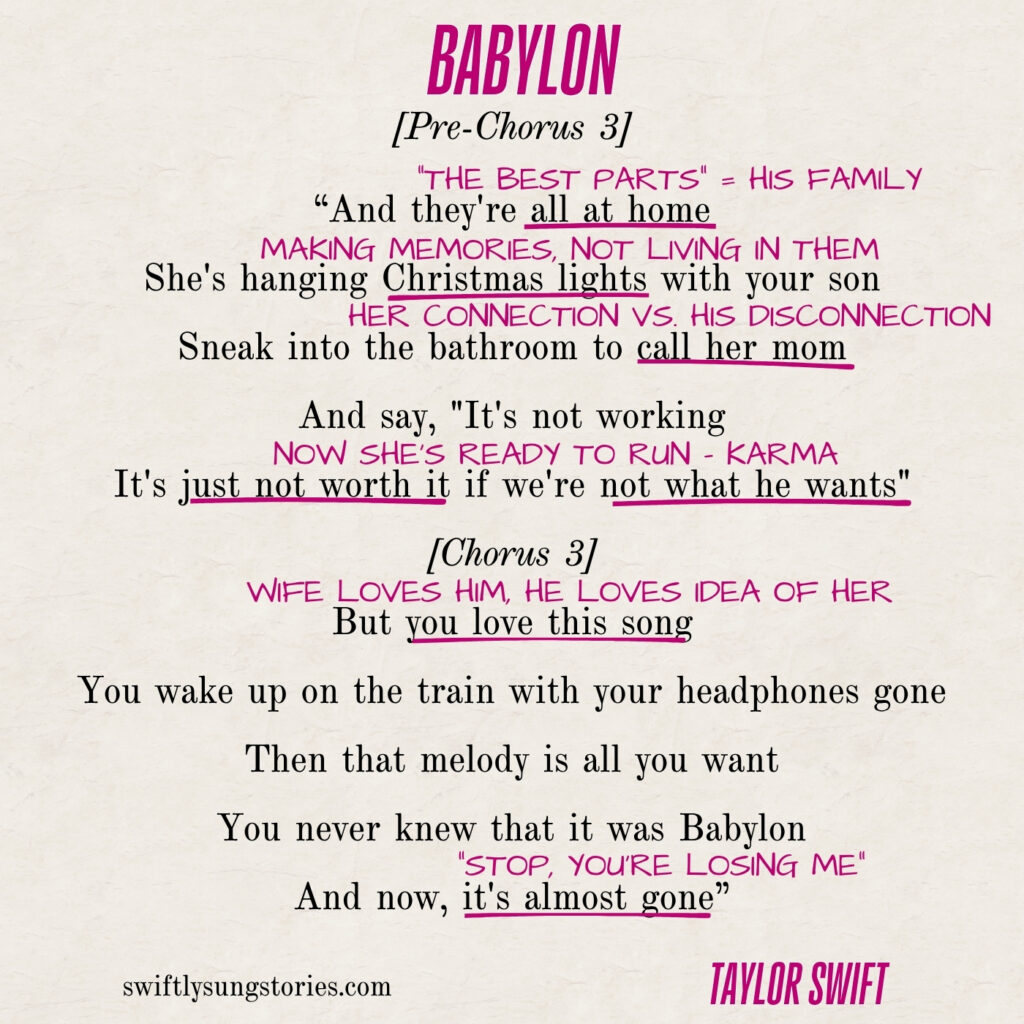
Where are “all the best parts”? “They’re all at home,” Taylor continues in the 3rd pre-chorus. They’re at home, and he’s sitting out in the cold.
Inside, it’s warm, and “she’s hanging Christmas lights with your son.” She’s making memories instead of living in them. She’s being in the moment instead of running away from it.
But then we zoom in on what this relationship is really like for her, and she’ll “sneak into the bathroom to call her mom.” She slips away from this time with her child – protecting him from this conversation that she’s about to have – and reveals what’s really going on inside.
She phones her mom to say, “It’s not working, it’s just not worth it if we’re not what he wants.” This line reveals a lot about their differences. In conflict, she reaches out for connection, while he runs away to disconnect. And while he’s quit a million little times by running away, it’s taken her a while to get to the point where she is ready to quit for good.
The bottom line is that she feels unwanted, and she feels unwanted because he’s never made her (or likely their son) a priority. Everything else – the money, and the mistresses, and the social climb – took precedent. And even when he was there physically, he wasn’t really there emotionally. And that’s a deep wound.
“But you love this song,” Taylor repeats. This time, she’s switched back to “love”, but it’s unclear whose perspective we’re in. If we’re in the woman’s POV, she loves him, and it’s going to be very hard to let go.
But if we’re in his POV, he loves her, and doesn’t want to let her go, but he also doesn’t know how to hold onto her. It’s slipping away – she’s slipping away – “and now, it’s almost gone.”
Like Taylor says in You’re Losing Me: “stop, you’re losing me. I can’t find a pulse, my heart won’t start anymore…for you.”
Final Chorus: The Fall of Babylon
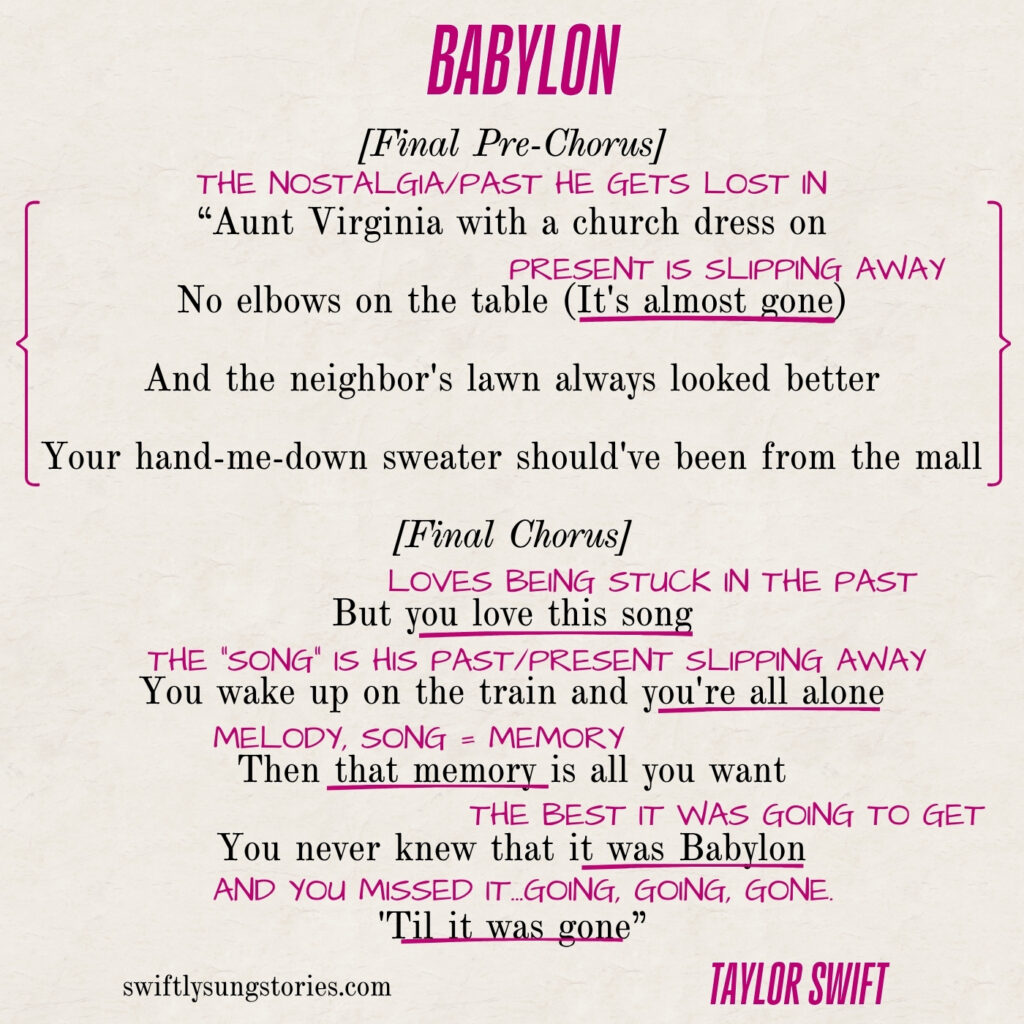
The final pre-chorus feels like it takes us on a ride through his nostalgia that he gets so swept up in. His mind traces the path back to Aunt Virginia, table manners, the neighbor’s lawn, and the hand-me-down sweater. This is where he lives instead of inside his life, hanging Christmas lights with his son.
And in the background, Taylor’s voice repeats: “it’s almost gone.” The past, and the present, are slipping away between his fingers, because he never learned how to hold onto what is important.
“But you love this song,” she reflects one last time. If “life is a song, it ends when it ends,” it’ll end a whole lot sooner if you don’t listen to the lyrics and lessons.
And before you know it, “you wake up on the train and you’re all alone.” This is where we learn that the headphone metaphor was really all about: letting people in. Companionship. Opening yourself up to the possibility of love and being loved. But for our protagonist, it’s too late. He didn’t listen, and now he’s alone.
And after she’s gone, “Then that memory is all you want.” Here’s our second revelation: “melody” was always code for “memory.” If you don’t live in the moment, and have gratitude for what you have, all you’ll be left with are memories. Never opportunities to make new ones.
You’ll only have the faint memory of that song, instead of the person to sing it with.
“You never knew that it was Babylon,” she repeats one last time, “’Til it was gone.”
And now it is gone. This story doesn’t end well for our central character, just like the mythic city of Babylon. He had it all, but he just couldn’t see it or appreciate it. He was his own downfall, and everyone else around him suffered the consequences.
Taylor’s Babylon Lyrics: Final Thoughts
Taylor’s Babylon lyrics are used to teach a lesson. In a song with biblical ties, it’s fitting that she’s written – essentially – a parable. It’s a morality tale that warns against greed, selfishness, and taking your life for granted.
But what’s most interesting to me about this song is that it paves a new road toward TS13. Taylor loves to string thematic threads between albums (see how Hits Different from Midnights leads directly into Fortnight from TTPD, for example). With Babylon, it feels like she’s steering away from the Showgirl glitz and glam (like the previous title track that formerly closed the album) and into something more introspective.
TS13 will be her most anticipated album to date, not only because it bears her lucky number, but because it will likely come around the 20th anniversary (or thereabouts) of her debut in the music industry.
This is going to be a BIG album, so to see this more self-reflective tone shift with Babylon, I’m anticipating TS13 to not only look back and see how far she’s come, but also to pave a new direction into her future.
More from The Life of a Showgirl


