
Taylor Swift’s “Patient Zero”: Lyrics Meaning, Literary Analysis & Themes
What does Patient Zero mean?
Taylor Swift’s track 13 on The Life of a Showgirl: The Encore is a dark, ominous exploration of narcissism, toxic relationships, and what it takes to escape.
In the lyrics, Taylor warns her villainous ex’s new girlfriend about his shady secrets. But what does the metaphor of “patient zero” mean, and what is Taylor really saying in this haunting track?
Here’s my full English teacher analysis, line by line.
- Title: “Patient Zero”, styled as “Patient Zer( )” in visuals
- Track: 13, The Life of a Showgirl: The Encore
- Written By: Taylor Swift, Max Martin & Shellback
- Pen: Fountain
What is Patient Zero About?
This track is told from the point of view of our narrator, who describes herself as “patient zero”. We learn that the “epidemic” or “disease” that she recovered from was a toxic relationship. This extended metaphor of disease, contagion, and addiction runs throughout the song.
The story begins with a phone call from this ex’s current partner, and our narrator reveals that she knows what’s likely going on inside their tumultuous relationship, because the same thing happened to her. Our narrator is the truth-teller, and tries to get the subject to see the reality of the situation she’s in.
Who is Patient Zero About?
Taylor has not explicitly revealed who may have inspired Patient Zero. She’s written about similar types of narcissistic characters before in songs like Vigilante Shit, my tears ricochet, no body, no crime, All You Had to Do Was Stay, Mr Perfectly Fine, and more.
But while the story seems to describe a past romantic relationship, it’s possible that this narrative is a continuation of one of the storylines from Showgirl.
The strongest correlation (in my opinion) is the villain from Father Figure, a similar narcissistic personality who uses charm and coercion to exert control. In the end of that story, the protege becomes the master, leaves the villain, and gains their power back.
It’s possible that Patient Zero is narrated by this same character who finally left the toxic relationship, and is now relaying the lessons learned to a character in a similar position.
What About The Patient Zero Music Video?
This track comes alive as a dark, gothic ghost story in Taylor’s music video, and extends the song’s plot with additional details and narrative devices.
In the video, the villain (played by Colin Farrell) has remarried to a new woman (played by Dakota Johnson). Taylor plays the original wife – his “patient zero” – and tries to warn Dakota that she’s in danger.
As the plot progresses and their relationship grows darker, we see Taylor appear and keep knocking over Dakota’s glasses and cups. Why? Because the husband has been poisoning her. Taylor even writes “run” in the spilled liquids.
Then comes the big plot twist: Taylor wasn’t just his “patient zero,” he actually killed her (probably with that poisoned wine), and then inherited her massive estate. She’s been haunting the husband who killed her, and is trying to save his new wife from meeting the same fate.
Intro: Where The Epidemic Began
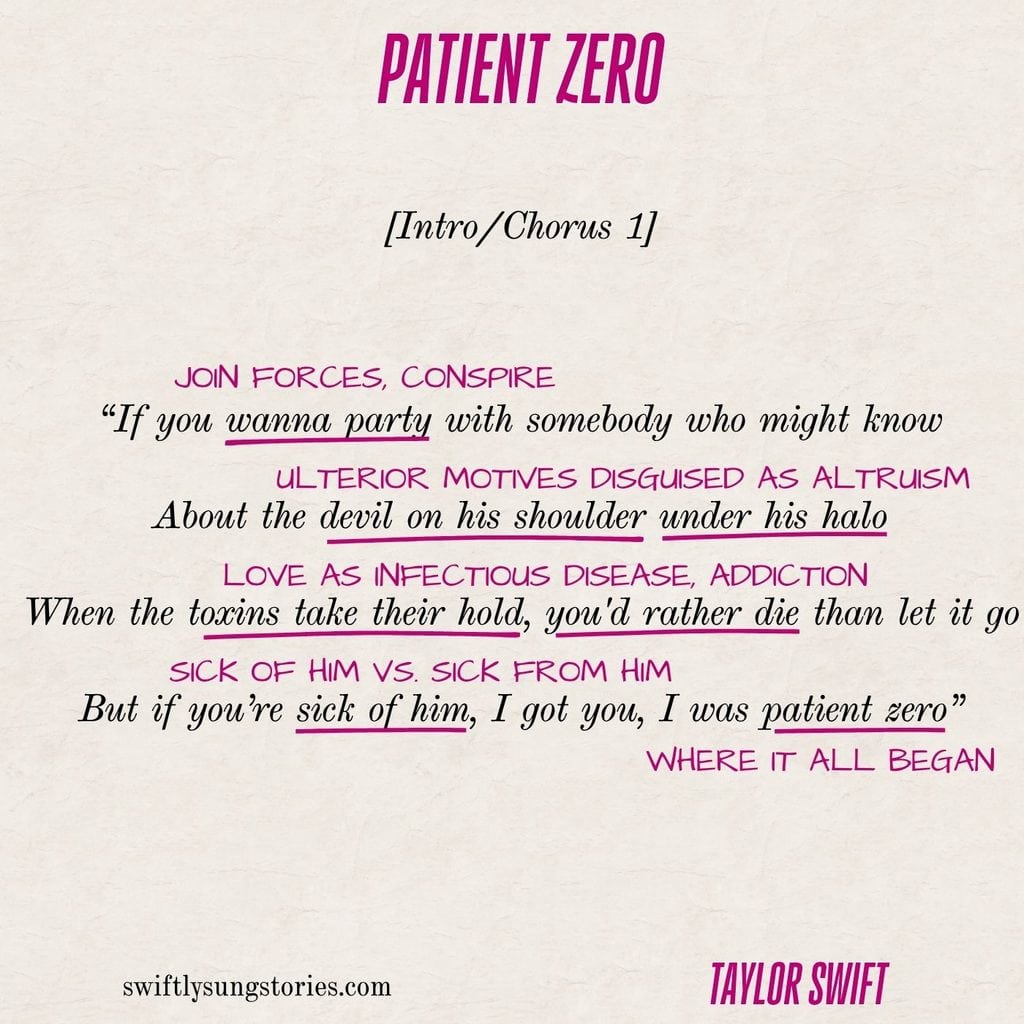
Taylor begins Patient Zero with a chorus, which she does very rarely. Here, it serves to drop us right into the middle of the story, give us some crucial information, and make us curious about what’s to come.
She kicks off this narrative with, “If you wanna party with somebody who might know.” Immediately, we’re intrigued. Who is our narrator talking to, where’s this party at, and what is she in the know about? This first line builds a huge amount of intrigue, and we’ll soon learn that she’s absolutely not talking about having a night at the club.
Then we learn the secret our narrator is keeping, and it’s “about the devil on his shoulder under his halo.” She’s introduced a third character, and this is who our narrative will mostly revolve around. He’s got a “devil on his shoulder,” meaning a crisis of conscience. An angel on one shoulder and a devil on the other is a common plot device that personifies a person’s internal moral battle: good vs. evil.
But there’s a couple of interesting things to note: he has no angel on his other shoulder. This isn’t an equal battle between good and evil. Instead, the devil is hiding “under his halo.” On the outside, he projects himself as angelic. Charming. Altruistic. But hiding under that facade of ‘I’m a good person’ lurks the truth: he’s not a good person at all.
“When the toxins take their hold,” she goes on, “you’d rather die than let it go.” Now we’re getting into the central metaphor of the lyrics: this devilish person as a disease or an addiction.
In this case, the “toxins” are the love of this man, and you immediately get addicted. “You’d rather die” shows just how intoxicating this person can be, but it also foreshadows the darkness that’s to come.
“But if you’re sick of him, I got you, I was patient zero,” she concludes the intro chorus. If you’re ready to get away from him, she’s saying, I can help you out. I’ve seen this film before, and I wrote my way out of the narrative. But why is she describing herself as “patient zero”?
In epidemiology, “patient zero” is the index case: the first person infected, or the first instance of the disease. “Patient zero” for our narrator could mean that she was his first victim. But other than diseases, what kinds of epidemics are there? Drug addiction epidemics. And that fits more appropriately with the metaphor she’s weaving here.
Love as a drug is a very common metaphor in Taylor’s language (see Clean, Don’t Blame Me, Glitch, Hits Different, Florida!!!, etc). And in all those previous uses of this metaphor, she falls into the thrill of the early “high,” hits rock bottom when it doesn’t work, goes through “withdrawal”, and then into recovery being “clean.”
In this metaphor, she sees another person suffering from addiction to this toxic person, and it’s a warning: you aren’t just “sick of him,” you’re sick from him. And you need to go cold turkey now. But you know what they say about helping those in active addiction? They won’t quit until they’re ready to quit.
Verse 1: Call Me?
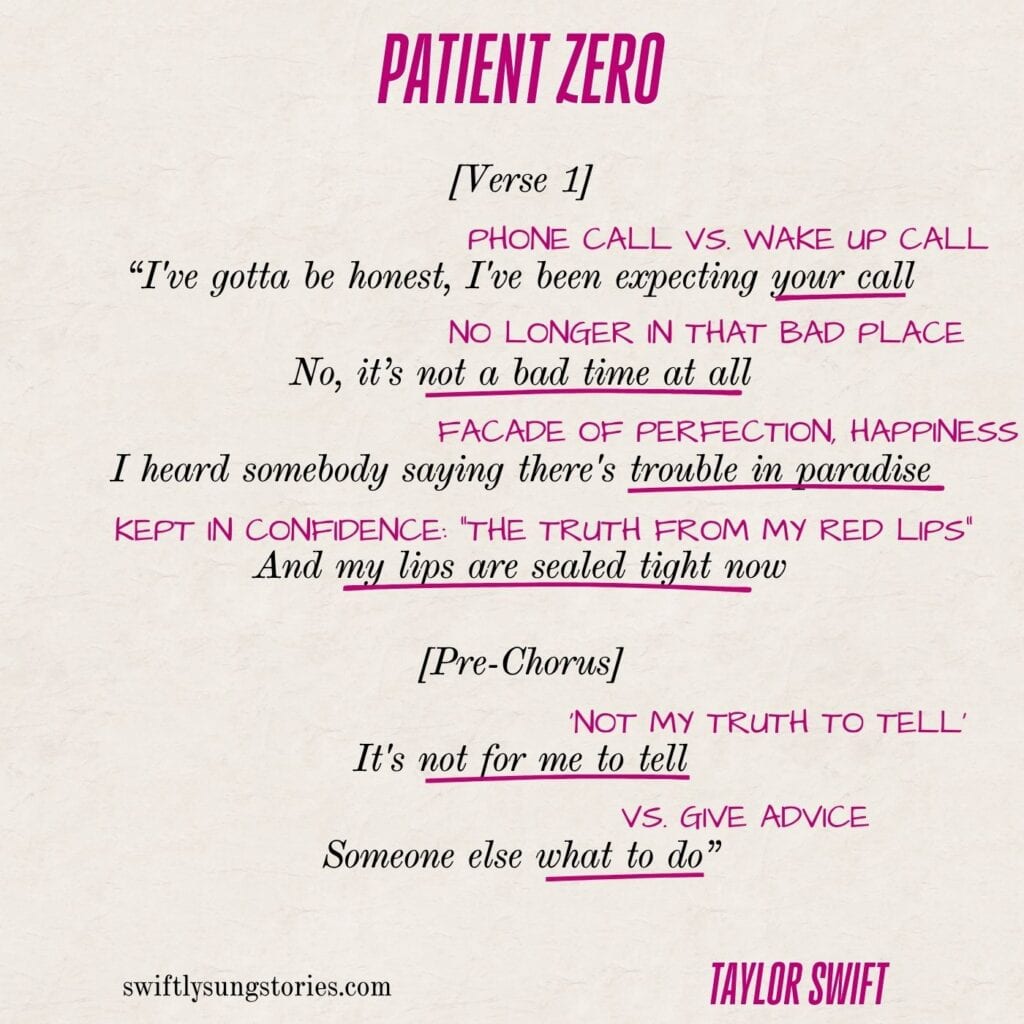
“I’ve gotta be honest,” she kicks off the first verse, “I’ve been expecting your call.”
It’s a common phrase – “I’ve gotta be honest” – but it usually means that a hard truth is coming. She was expecting this person to reach out: she knows exactly why she’s calling.
“No, it’s not a bad time at all,” she says. Normally this would be a response to,”is it a bad time to talk?” But here, it serves to contrast with her past with this toxic ex. It WAS a bad time (like in long story short), but she’s in a much better place. But our subject is still in that “bad time,” and needs help getting out.
“I heard somebody saying there’s trouble in paradise,” she tells her. She’s heard through the rumor mill that her ex’s new relationship is not what it seems to be. “Trouble in paradise” is an idiom that means something looks perfect on the surface, but is crumbling underneath. We’ll learn that this idiom applies not only to their relationship, but to him as well.
“And my lips are sealed tight now,” she reassures her, and this is a loaded line. Her lips are sealed, as in this conversation will be kept in confidence. But her lips have also been sealed up until now: she hasn’t revealed the truth about this crazy ex. It’s also a lie, because her lips are about to open up and tell the most blatant truths about what he’s really like.
In the music video, these lines like “my lips are sealed tight” and “it’s not a bad time at all” have even more significance: Taylor is a ghost. She has all the time in the world, and she literally can’t tell anyone a thing because she’s dead.
“It’s not for me to tell,” she continues, “Someone else what to do.” She’s being purposefully tentative here; trying to seem gentle and neutral. But on the inside, she wants to scream: “get out now!”
That’s exactly what she’ll do in the chorus that follows, repeating what we’ve heard before: he’s toxic, he’ll ruin your life, and I know this, because he ruined mine.
Verse 2: Love-Bomb Goes Ka-Boom
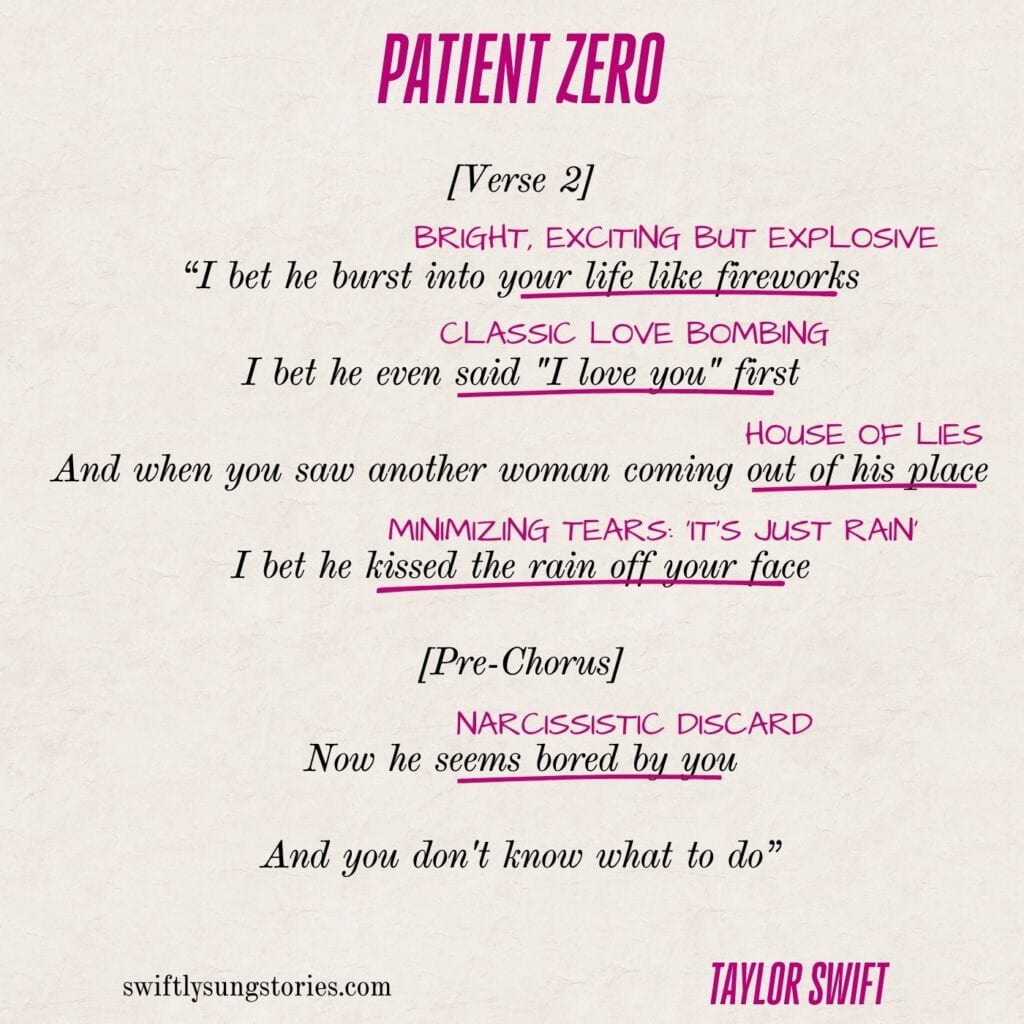
The second verse sees our narrator read their relationship like a book.
“I bet he burst into your life like fireworks,” she says. He came in hot and bright: exciting, thrilling, lighting up the dark. But what else are fireworks? Explosions. Destruction. Detonation.
“I bet he even said ‘I love you’ first,” she surmises. What she’s describing is classic love-bombing, where a narcissist comes on hard and fast, overwhelming you with adoration. It’s easy to fall for, and it’s easier to be blinded by (like fireworks).
“And when you saw another woman coming out of his place,” she continues, “I bet he kissed the rain off your face.” We can picture this new woman standing outside of his house – which turns out to be a house of lies – and watching another woman leave. She thought she was the only one. He told her he loved her.
And how does he respond? He kisses the tears from her cheeks. But they’re described as “rain,” meaning either the woman minimizes her tears by calling them rain, or HE minimizes them, and assumes it’s rain. Either way, her emotions are being manipulated.
“Now he seems bored by you,” she says, guessing that the same pattern that happened to her is happening to the new girl. This is the discard phase of the narcissist, where they aren’t getting their supply from you anymore and they move onto greener pastures. This happens especially fast if they feel you see through them.
“And you don’t know what to do,” our narrator observes. She’s been in this place before, and she knows the desperate confusion that follows. What do you do when the person you think you love – and you think loves you – suddenly seems disinterested? It’s especially confusing when everyone else sees this person as charming and perfect: will anyone believe you?
Chorus 3: Time is Ticking
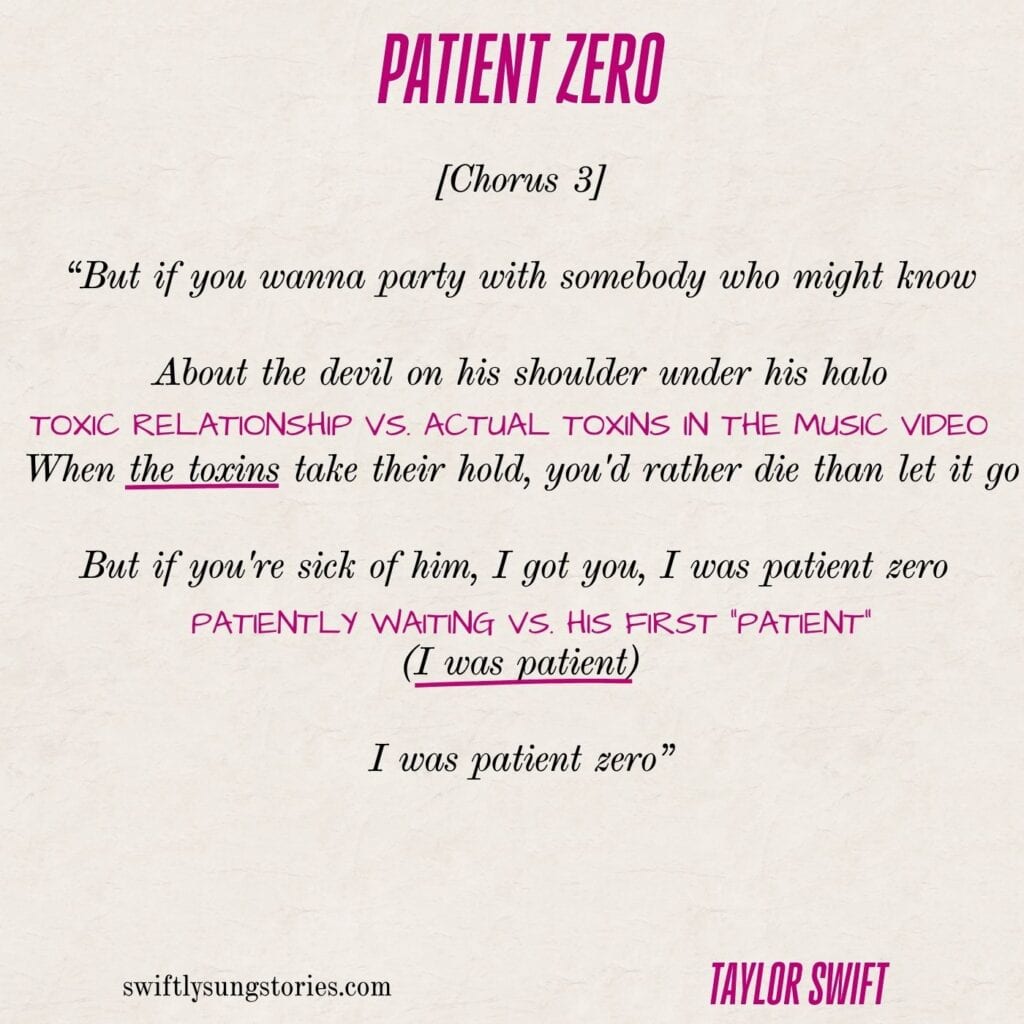
The third chorus repeats almost word for word, but – just like in most of Taylor’s songs – with repetition comes revelation. And by now, we can see that she’s not inviting our subject to a party to get drunk and complain about Mr Perfectly Fine.
So what else is a “party?” A group, for one, and one that has a common purpose: a search party, a party of two in a restaurant. There’s also a party in a lawsuit: a group taking one side in a dispute. There’s a political party, joining forces for common belief or action. These all fit.
But there’s also “a party to,” which means to become involved in or become complicit in (for example, “I refuse to be a party to your lies anymore”). And that’s what I think our narrator is getting at here: come on over to my side, let’s join forces, and we can take him down together. Leave the dark side and come on over to the light.
Another interesting evolution is “toxins”, because by now we realize that not only is this man intoxicating, he’s also just plain toxic. Nasty. Poisonous. Infectious. Addictive. And he can make you incredibly sick mentally and emotionally.
In the music video, Taylor takes this metaphor further and illustrates the husband physically poisoning the new wife.
Then we get one addition to the repeated lyrics: “I was patient…I was patient zero”. Here she’s pointing out the double meaning of patient. There’s patience, like biding your time, and there’s being a patient, like in a medical treatment setting.
By now we get the sense that she was the first girl he tried this with. Like a devious doctor, he experimented on her as “patient zero”. She was lucky and got out alive.
But “patient zero” could also mean she’s run out of patience for his lies and manipulation. She’s done being silent, and she’s now going to reveal it all. And she does, in the bridge that follows.
Bridge: Free Solo Social Climber
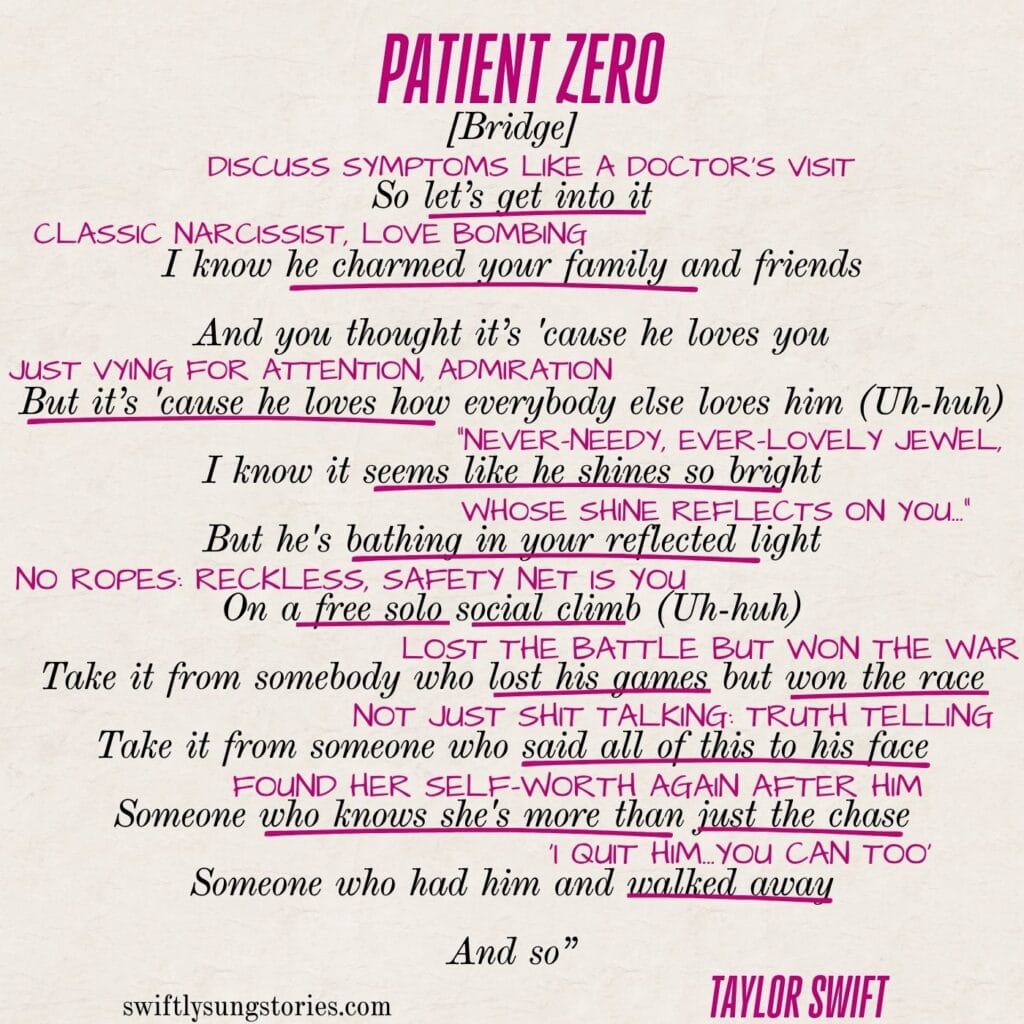
In the bridge, she gets into the heart of what makes this villain tick. “So let’s get into it,” she says, before reading him like a book.
“I know he charmed your family and friends,” she says of his entrance into her life, “And you thought it’s ’cause he loves you, but it’s ’cause he loves how everybody else loves him.” He’s not being genuinely charming; he’s ingratiating himself into her world because he wants attention.
“I know it seems like he shines so bright,” she says, reflecting the earlier firework simile, “But he’s bathing in your reflected light.” ‘You’re the one who shines,’ she’s saying, ‘and he likes that it allows him more attention.’ But what other lyrics does this remind you of?
“The idea you had of me, who was she? An ever-needy, ever-lovely jewel, whose shine reflects on you.” It’s the same metaphor from All Too Well [10-Minute Version], and the male character in that song has a very similar M.O.
But he’s not just basking in the attention he gets from being with her: he has a larger goal in mind. He’s “On a free solo social climb.” This is a really clever combination of two phrases.
To “free solo” is to climb without ropes and harnesses ala Alex Honnold. Some say it’s crazy and reckless. Some think it’s admirable.
A social climber is a person who strategically makes friendships and business relationships in order to elevate their status in society.
Combining the two, this means he’s climbing the social ladder with no backup plan, and with complete disregard for who he has to step on to get to the top. ‘He’s using this romantic relationship for his own gain’, our narrator tells this new woman.
In the music video, we learn that he’s literally killed his former wife to climb the social ranks, and inherited her massive empire.
“Take it from somebody who lost his games but won the race,” she continues, comparing his manipulation to a game of strategy. This is a play on the common saying, ‘lost the battle but won the war.’ His games – his manipulation, his narcissism, his lying – were the small battles she may have lost. But she “won the race,” meaning either she outran him and got away, or beat him in the larger game of life (or morality, at the very least).
“Take it from someone who said all of this to his face,” she says, explaining that this isn’t just talking smack or gossiping. She isn’t saying anything to this new woman that she hasn’t already told him. She’s establishing credibility, trying to get her to believe that this person is bad news.
Then she builds more credibility, explaining that she’s “someone who knows she’s more than just the chase, someone who had him and walked away.” Once she got out and got away, she realized that she was worth so much more than the love-bombing and lying and manipulation. She now knows what kind of love she deserves, and she doesn’t want this woman to make the same mistakes.
Final Chorus & Outro: Kick Him to the Curb
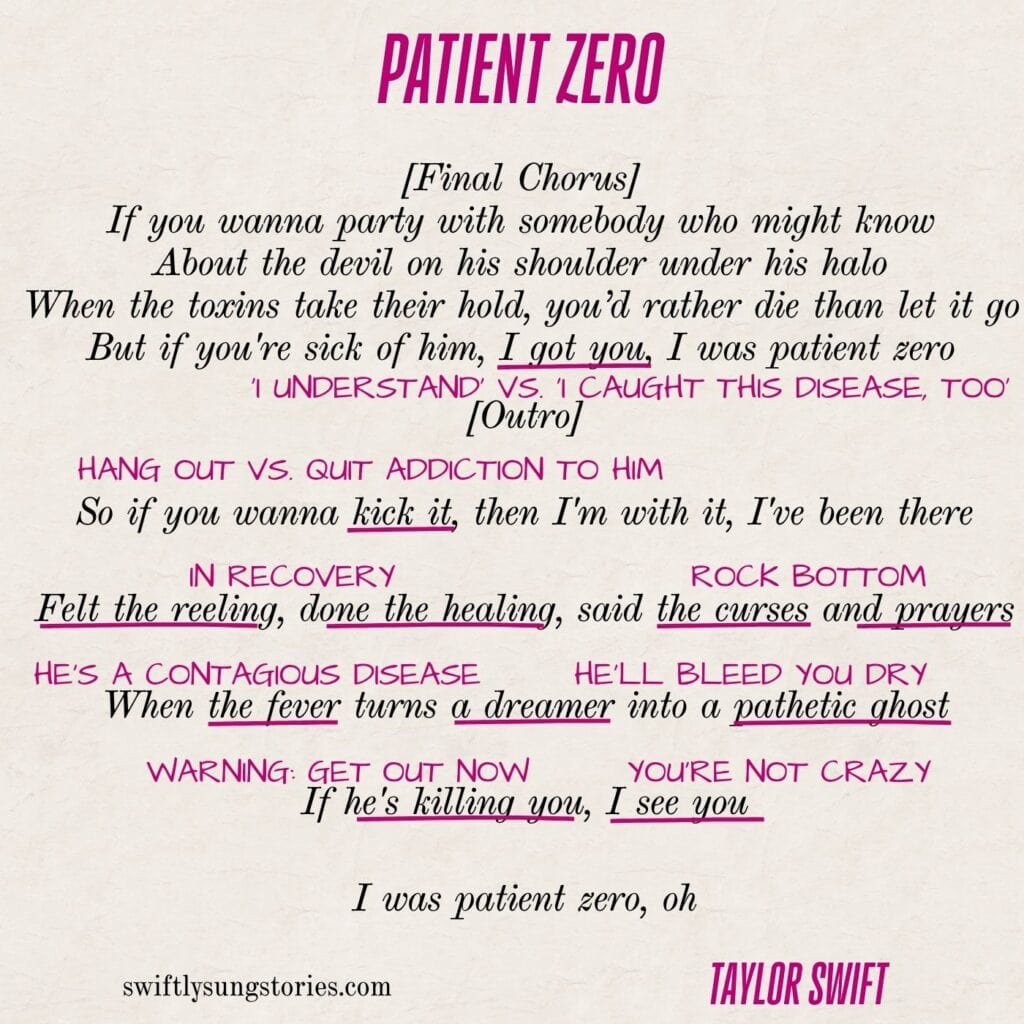
The final chorus repeats word for word, but this time one phrase caught my attention more than the rest: “If you’re sick of him, I got you.” By this point it feels like ‘I understand what you’re going through, I’m going to help you through this.’ But it also feels like, ‘I caught this disease and survived, and I’m now immune. You will get there, too.’
“So if you wanna kick it,” she continues in the outro, “then I’m with it, I’ve been there.” Like the previous “if you wanna party,” “if you wanna kick it” is a play on the ‘let’s hang out’ phrasing. To “kick it” means to hang out, yes, but it also means to kick a habit. ‘If you’re ready to kick him to the curb,’ she’s saying, ‘I’ve done it, and I can show you how.’
Then she tells the subject what the future holds: “Felt the reeling, done the healing, said the curses and prayers.” It’s like the stages of grief that she’ll have to go through. First, you’ll reel into depression, sadness, withdrawal. Then, you’ll start to heal. But healing isn’t linear, and the “curses” and “prayers” will be a part of your journey to getting clean.
Then she says one of the most visceral lines of this track: “When the fever turns a dreamer into a pathetic ghost.” What was once a feverish obsession of new love is now just a plain fever: an illness that you have to recover from. And like any drug addiction, it’ll crush your dreams and turn you into a “pathetic ghost” of your former self.
But there’s hope on the horizon, and she reaches out a helping hand. “If he’s killing you, I see you, I was patient zero, oh.” In the beginning, “you’d rather die than let it go.” But then you actually start dying, and your only hope is to reach out for help and save yourself.
So…What’s Up With Patient Zero?
In the music video, Taylor’s ghost saves Dakota Johnson’s character and she escapes an abusive marriage, or it’s implied that she escapes. But the lyrics themselves don’t suggest a happy(ish) ending, and it’s up to us to determine what it all means. So what does it mean?
Within the larger setting of Showgirl, I think Patient Zero exists in the dark underbelly of this album that is described in songs like Cancelled!, Father Figure, and The Life of a Showgirl. Patient Zero just removes most of the showbiz setting and zooms in on one particular arch-nemesis.
In Father Figure, the student becomes the master and kicks their abusive mentor to the curb, but here, we don’t get a tidy ending. The villain character in Patient Zero could represent any number of Hollywood moguls or wannabe-moguls, social-climbing their way to the top and stepping on any woman who gets in their way.
In that vein, Patient Zero is a warning, just like those previous tracks I mentioned are warnings: this business – this world – is perilous for women. And in The Life of a Showgirl, every missed step is a mis-step. Women don’t get a do-over, so you have to tread carefully.
And that’s how you love – and stay alive – in The Life of a Showgirl.
More from The Life of a Showgirl
- The Fate of Ophelia
- Elizabeth Taylor
- Opalite
- Father Figure
- Eldest Daughter
- Ruin the Friendship
- Actually Romantic
- Wishlist
- Wood
- Cancelled!
- Honey
- The Life of a Showgirl
- Cleveland!
- Pink Clouding
- Babylon


