“Robin” Song Meaning: Full Analysis Of Taylor’s Tricky Track
Taylor Swift’s penultimate track on The Tortured Poets Department is the lovely and lyrical Robin.
This song seems to be addressed to a child, whom the narrator wishes will keep their wild ways into adulthood. But the layers of the lyrics go much deeper than that, and this track also has some interesting literary references.
Here’s my full English teacher analysis of Taylor’s Robin song meaning, line by line.
Robin by Taylor Swift
- Title: Robin
- Written by: Aaron Dessner, Taylor Swift
- Track: 30, The Tortured Poets Department: The Anthology
- Pen: Quill
- Lyrics from Genius
Robin Lyrical Analysis: Narrative Summary
- Setting: In childhood, before the realities of the adult world come crashing in.
- Characters: Narrator (Taylor, as herself or as someone else), Subject (likely a child).
- Mood: Wistful, nostalgic, cryptic and secretive.
- Conflict: The adult world is full of terrors, and this child will have to face them eventually.
- Inciting Incident: “You have no idea”: the subject doesn’t know what’s coming in the future.
- Quest: Maintain childhood innocence and perseverance while growing up.
- Symbols, Similes, Hidden Meanings & Metaphors: “Robin,” “long may you reign,” “animal,” “bloodthirsty,” “out window panes talking utter nonsense,” “you have no idea,” “strings tied to levers / slowed-down clocks tethered,” “showmanship,” “in sweetness,” “way to go, tiger,” “higher/wilder/lighter,” “for you,” “roar at your dinosaurs,” “a just ruler,” “covered in mud,” “buried,” “out of your reach,” “secret we all vowed to keep,” “dragonflies above your bed,” “swing set,” “dreams,” “regrets,” “cruel and mean,” “bounce back just like your trampoline,” “curtail your curiosity.”
What is Robin About?
Robin is about growing up, and secrets that are kept from children to maintain their innocence.
Taylor uses childhood metaphors and imagery to depict this upcoming growth, and describes significant secrets that are kept from the subject to keep them “in sweetness.”
Who is Robin About?
Taylor has never revealed who may have inspired Robin, or who the song may be about.
Some fans theorize that it’s dedicated to her collaborator Aaron Dessner’s child named Robin. Others think it could allude to Christopher Robin of Winnie the Pooh.
The name “Robin” means famed, bright, and shining, which could hold a clue to the subject. The bird, similarly, usually represents good luck and good fortune.
From my thorough dissection of the lyrics, I’ve come up with three possible interpretations:
- It’s a song written to her younger self.
- It’s a song written to another child (possibly inspired by Christopher Robin, or Aaron Dessner’s child Robin).
- It’s a song about her hopes for future generations.
We’ll explore all three below.
Robin and William Blake
Two very famous poems use the same animal metaphors as Taylor’s Robin.
William Blake, one of the British romantic poets (whom Taylor sang about in the lakes), was fascinated with the intersection of the natural world and the divine.
Two of his most famous works are – you guessed it – about a tiger and a robin (metaphorically).
The Tyger by William Blake
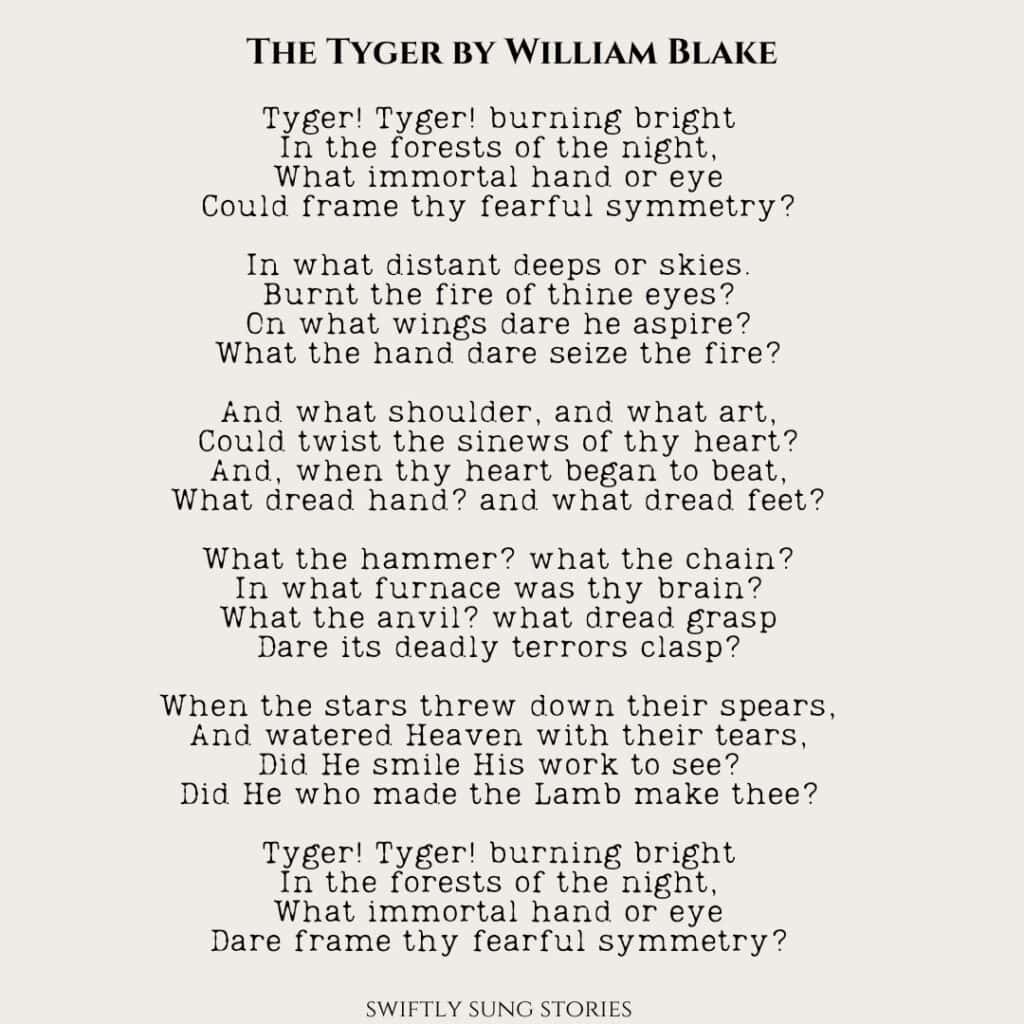
The Tyger exists in parallel with Blake’s The Lamb, where the lamb represents mankind’s innocence, and the tiger is mankind’s evil.
The tiger in Blake’s poem is a metaphor for mankind, and essentially asks what kind of god could have made creatures that are capable of both such beauty and such destruction.
Thematically, Taylor’s Robin and Blake’s Tyger are discussing the same issues: innocence vs. experience, and good vs. evil.
Blake’s poem about a robin also discusses similar themes.
Three Things to Remember by William Blake
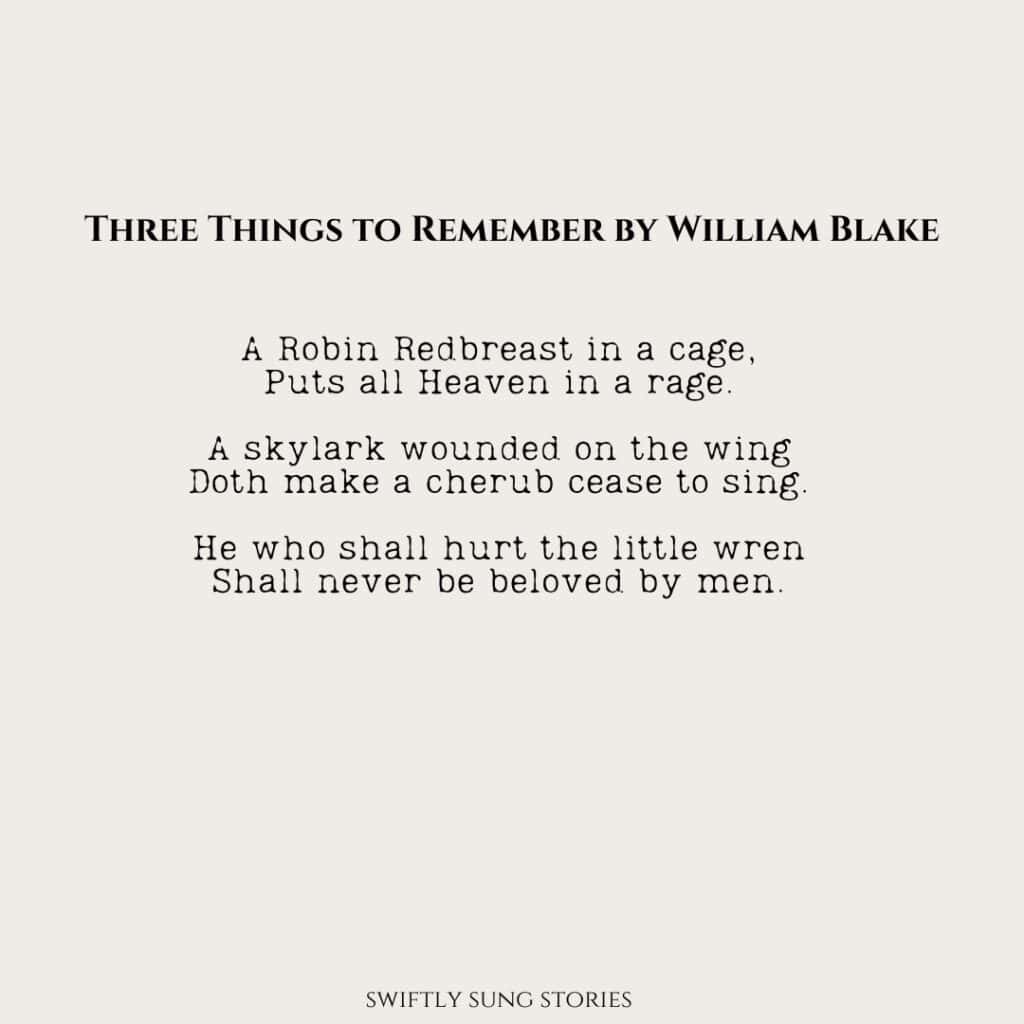
This much shorter poem is about the cruelty of the world, with the robin representing a defenseless, pure soul whom man only wants to cage. Taylor’s Robin is much the same: an innocent child, who will have to deal with the harsh realities of the world eventually.
Blake’s poetry isn’t about the animals themselves, just like Taylor’s song isn’t really about a robin or a tiger. It’s what the animals represent: innocence vs. violence, good vs. evil, man vs. the divine.
These themes of the divine vs. the mortal, beauty vs. terror, and good vs. evil flow through all of Blake’s poetry and all of The Tortured Poets Department: The Anthology, which is why it may be pertinent to discuss these poems alongside Robin.
I’ll discuss these poems and their parallels more in my full analysis below.
Robin Lyrics Meaning: Line by Line

From the outset, the tone is of an adult talking to a child.
“Long may you reign,” she says in the first line, alluding to a ruler of a kingdom. From the jump, this is a clue that the subject of the song could be Taylor herself (or a younger version of herself).
Taylor has described her career as a kingdom in several previous songs, including Long Live, Look What You Made Me Do, New Romantics, hoax, The Archer, long story short, Bejeweled, and others.
But the “kingdom” could also represent any child’s imaginary world, where they are the center of their narrative, and can play out their most elaborate fantasies without a care.
“You’re an animal,” she says to the subject, “you are bloodthirsty.” The subject is feisty and fearsome, just like the tiger of Blake’s poem.
When children are small, they have yet to be tainted by the harsh realities of the world, and can maintain their fearsome, bold qualities until they grow up. They don’t know any better yet, but somewhere along the way, we all lose that chutzpah.
The subject is “Out window panes talking utter nonsense,” which feels very much like a parent watching a child playing pretend in the backyard.
“You have no idea,” she says to them, alluding to darker times ahead.
Right now, the child is like the robin: innocent and clueless to the harsh realities to come. But they are also the tiger: bold, strong, and capable of greatness. In this moment, they have a magical combination: innocence and strength.
1st Pre-Chorus & Chorus: “Strings Tied to Levers”

“Strings tied to levers,” Taylor says in the pre-chorus, “Slowed-down clocks tethered.” This sounds like some kind of elaborate machine, where if a string is pulled, the lever will activate something.
The clock – which has been slowed down – can’t move. It’s tethered in place, stopping time from moving forward. This feels like it’s restricting growth or change, or tricking the subject into not moving forward.
“All this showmanship,” she says of these elaborate gadgets rigged up to conceal something, “To keep it for you in sweetness.”
The “showmanship” is likely the elaborate lengths adults will go to in order to disguise the evil in the world. We slow down the clocks with ruses like Santa Claus and the tooth fairy, and monitor our children’s consumption of media that could scare them.
“To keep it for you in sweetness” describes this big secret: that the world is actually scary, and full of things that can harm us.
If we can keep this secret, our children can stay in their “animal” and “bloodthirsty” era longer. We can slow down the clock that – when it strikes midnight – will turn them into jaded adults.
This is the central conflict of Blake’s poems: how both good and evil can exist in the world, and how we’re supposed to navigate this tricky place that’s full of contradictions.
For parents, this is our existential crisis: how do we bring children into this messed up world, and how do we best prepare them for the future?
“Way to go, tiger,” Taylor says in the chorus, “Higher and higher.” “Way to go, tiger” is – at least in America – a common way to praise a child. If your kid hits a homerun, you might say “way to go, tiger!”
🪶🤍 Are you a tortured poet? Find out with my TTPD Lyrics Quiz! 🤍🪶
The tiger represents the youthful boldness of a child. Saying “way to go, tiger” is like saying, ‘yes, my love, stay in this blissful state for as long as you can.’
Blake’s tiger represents the beauty and the terror of mankind, and it’s similar here. We hope our little “tigers” can stay both innocent and fearsome, even as they grow and age.
“Higher and higher” encourages the child to aim higher in their aspirations, and “Wilder and lighter / For you” encourages them to stay wild and free for as long as possible, like the tiger or the robin.
The central fear for the tiger is that it will become violent, and the central fear for the robin is that it will become caged. It’s a delicate line to walk, to steer our children in the right direction while still maintaining their innocence.
Verse 2: “Long May You Roar at Your Dinosaurs”

“Long may you roar,” she says in the second verse, “At your dinosaurs.” Like the rest of the lyrics, this could have several possible interpretations.
- It’s simply wishing a child to stay wild and imaginative.
- “Dinosaurs” are people who have outdated viewpoints, and the child “roars” at them in protest.
Either way, it encourages this person (younger Taylor, or an unknown child) to stay brave and keep causing a ruckus.
“You’re a just ruler,” she says, which means that the subject is a fair and moral ruler of their “kingdom.” They aren’t hasty or vindictive in their imaginary realm – they’re a good person.
To me, this feels like Taylor’s hope for future generations. The “dinosaurs” will soon go extinct, and today’s children will go on to take the reins toward a more equitable future.
The subject is “Covered in mud, you look ridiculous,” she says, “And you have no idea.” The subject doesn’t know how silly this all looks from an outsider – or grownups’ – perspective. But they also don’t know that they shouldn’t want to grow up.
“Buried down deep,” she says, “And out of your reach / The secret we all vowed / To keep it from you in sweetness.”
The subject is covered in mud because they were digging for secrets: they were trying to grow up too fast. This could symbolize a child’s growth and maturity, and the “digging” is part of their lifetime of discovery.
“The secret we all vowed / To keep it from you in sweetness” is what’s buried, and it’s what the “strings tied to levers” are trying to disguise. It’s what “all this showmanship” is for.
The secret is that the world is full of evil (just as in Blake’s The Tyger and Three Things to Remember) and we bury that truth in the hopes that our children won’t have to uncover it until they’re good and ready.
Bridge: “We’ll Curtail Your Curiosity, In Sweetness”

The chorus repeats, and then she opens the bridge with “You got the dragonflies above your bed.” This could describe a simple childhood bedroom decoration, but dragonflies usually represent better times ahead: luck and good fortune (much like a robin redbreast).
In their bed is where they dream, so the dragonflies above could symbolize their dreams of success later in life; their hopes for the future, and our hopes for their future.
“You have a favorite spot on the swing set,” she says, describing the place where they like to fly “wilder and lighter.” It’s another place where the child can dream and stay innocent.
Taylor also describes swings in seven: “In the swing / Over the creek / I was too scared to jump in.” In both cases, the swing represents the leap from innocence to experience: from childhood to adulthood.
“You have no room in your dreams for regrets,” she says, “You have no idea.” They have no idea what harshness is coming for them; they’ll have a lot of regrets later on, but for now, they don’t have to worry about it.
“The time will arrive for the cruel and the mean,” she says, echoing a similar sentiment as in Innocent and Never Grow Up. The real world is coming, and it’s coming fast, so she urges the subject to stay innocent for as long as possible.
“You’ll learn to bounce back just like your trampoline,” she says, echoing a familiar line from Labyrinth: “You know how much I hate that everybody just expects me to bounce back / Just like that.”
The time will come where they’ll have to learn to “bounce back” from mistakes or missteps, and it won’t be easy. But they will rebound, time and time again.
“But now we’ll curtail your curiosity,” she says, “In sweetness.” For now, they don’t need to learn to bounce back: they don’t even need to know what it feels like.
The ruse, to keep the subject “in sweetness”, will hide all these realities from view, and allow them to continue on in their blissfully ignorant state.
Final Chorus: “Wilder and Lighter For You”

The chorus repeats to finish out the track, closing with “higher and higher / wilder and lighter / for you.”
“For you” could mean two things: ‘I do these things for you, to keep you innocent,’ or ‘I wish these things for you.’ Either way, the sentiment is directed toward “Robin” or the robin.
So who is “Robin,” or the robin? It’s a child, and it’s likely any child, including younger Taylor.
The robin in Blake’s Three Things to Remember symbolizes the innocence of delicate creatures, like children. The world will slowly try to hurt, corrupt, and cage them, but adults try to prevent this for as long as possible.
🪶🤍 Are you a tortured poet? Find out with my TTPD Lyrics Quiz! 🤍🪶
Grownups will go to “higher and higher” lengths, and put on “wilder and lighter” ruses to disguise the harsh realities of the real world, “for you.”
As adults, we all mourn the loss of our former selves. We used to be the carefree child playing in the mud, blissfully unaware of how silly we looked to other people.
So what do we do when we have our own children? Keep them in the place we still wish we could be. We stop the clocks for them, because we weren’t able to do it for ourselves.
We’ve watched some of mankind become the tigers, who lash out at anyone who comes close. And we’ve watched some of us become the robin, defenselessly caged and trapped, prevented from flying free.
We don’t want either of these things for future generations. We do all we can – and maybe in vain – to “keep it for you in sweetness,” so that the harsh real world can’t come inside our family bubble.
Will it work? No. But as we mourn our past selves, we can try to turn back time for our offspring, because it’s the only thing we can do.
Robin Meaning: Final Thoughts
The central message of Robin is that innocence and optimism should be protected. While Blake ponders how this world came to be as it is, Taylor ponders how we – and future generations – can navigate this world and maintain our most innate qualities.
Can our children keep their tiger-like ferocity, as well as their robin-like innocence? It’s something Taylor has questioned over and over about her own life: how did she come to be where she is, and how can she keep herself from becoming jaded?
Above all, Robin describes the hope that this child – all children – can keep both their innocence and their chutzpah and carry it with them into the future.
If they can reach adulthood without major scars – like she has, and like all adults have – humanity will be better off.
More Songs From The Tortured Poets Department
- Stevie Nicks’ TTPD Prologue Poem
- TTPD Epilogue Poem “In Summation”
- Fortnight
- The Tortured Poets Department
- My Boy Only Breaks His Favorite Toys
- Down Bad
- So Long, London
- But Daddy I Love Him
- Fresh Out The Slammer
- Florida!!!
- Guilty As Sin?
- Who’s Afraid of Little Old Me?
- I Can Fix Him (No Really I Can)
- Loml
- I Can Do It With A Broken Heart
- The Smallest Man Who Ever Lived
- The Alchemy
- Clara Bow
- The Black Dog
- Imgonnagetyouback
- The Albatross
- Chloe or Sam or Sophia or Marcus
- How Did it End?
- So High School
- I Hate it Here
- thanK you aIMee
- I Look in People’s Windows
- The Prophecy
- Cassandra
- Peter
- The Bolter
- The Manuscript


