
English Teacher Explains “The Fate of Ophelia” Lyrics Meaning
Taylor’s opening track to The Life of a Showgirl is the incredible The Fate of Ophelia, which establishes the theme and tone for the rest of the album. But what does this song really mean?
Let’s look behind the curtain of Hamlet metaphors, modern-day phrasing, and the glitz and glam to pull apart what she’s getting at in this crucial track.
I’m your Swiftie English teacher, and this is the meaning behind The Fate of Ophelia, line by line.

- Title: “The Fate of Ophelia”
- Track: 1, The Life of a Showgirl
- Written By: Taylor Swift, Max Martin & Shellback
- Pen: Fountain, with a dash of quill & glitter gel pen
The Fate of Ophelia Narrative Summary
- POV: First person, told from a tragic heroine’s perspective and addressed to her “white knight”
- Setting: In the present, looking back over past memories and into the future
- Characters: Narrator (would-be “Ophelia”), subject (“you” who saves her)
- Mood: Upbeat, grateful, optimistic
- Conflict: Fated to “drown in the melancholy”
- Inciting Incident: “I heard you calling on the megaphone”
- Quest: Avoid the fate of Ophelia, who drowns after being driven mad by men.
- Theme: Fate & destiny, fairytale endings, old vs new.
Line-by-Line Breakdown
Taylor chose to start this album with an incredibly dense song, and while this track sounds like a peppy, perfect pop ditty, the writing isn’t just surface-level.
She contrasts her Hamlet references with modern-day slang, juxtaposing old and new, and rewrites the tragic “fate of Ophelia” into something starry-eyed and optimistic.
Let’s break it down, one verse and chorus at a time.
***Please note, this is only my interpretation of Taylor Swift’s writing. Art is subjective, and the only person who truly knows what these lyrics mean – or what she intended them to mean – is Taylor herself.
What these lyrics mean to you is really what matters, and there is no single “correct” interpretation. I hope my annotations below I can simply point out things you may have missed, open the door to alternate meanings, and draw parallels between Taylor’s other lyrics and art.
Verse 1: The Siren Song
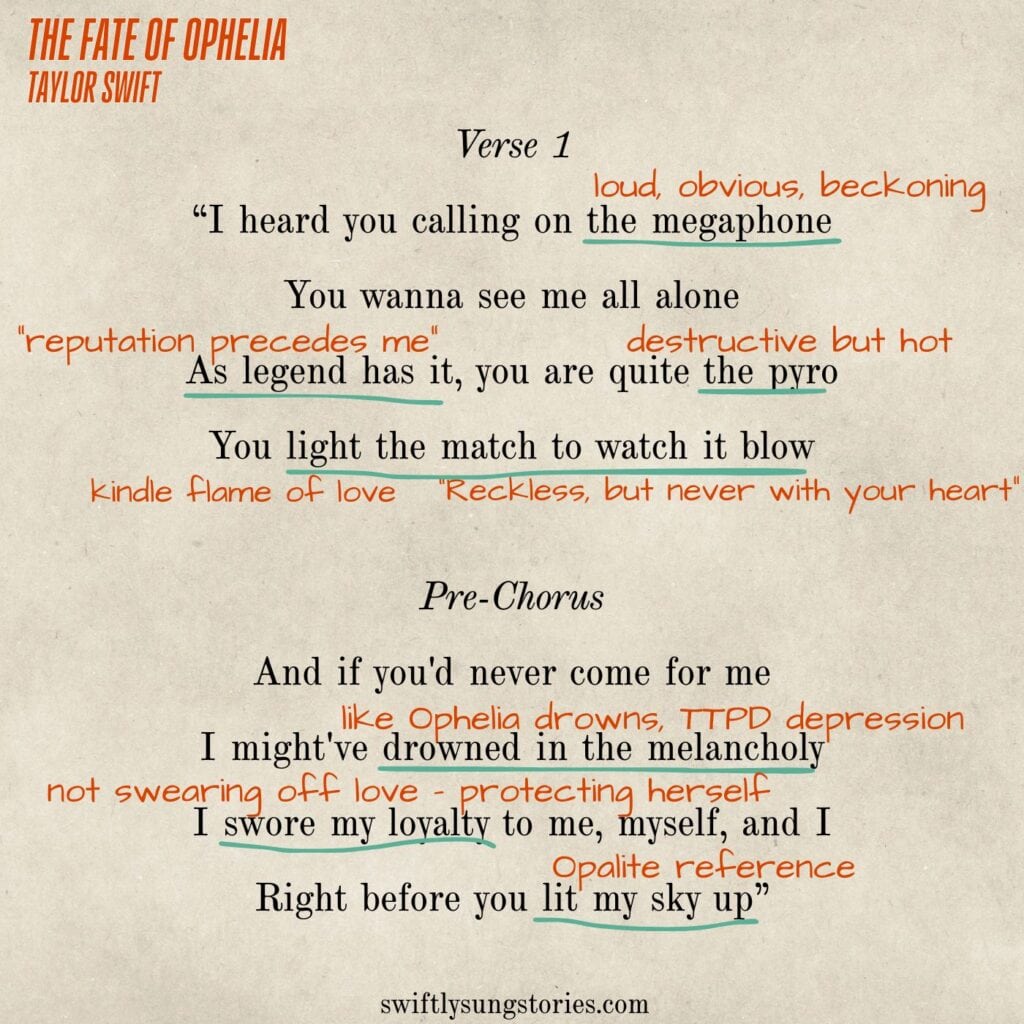
“I heard you calling on the megaphone,” she begins the first track of her new album and era. We’re in the present tense, looking back at the past.
Likely alluding to Travis Kelce’s use of his popular podcast, New Heights, as a “megaphone” to get her attention, we’ve also seen lots of megaphone imagery in this album promotion. This isn’t a quiet call or text – it’s a shout, as if from the universe, or a siren song. The siren imagery is also reflected in the music video in the ship scene.
“You wanna see me all alone,” she hears her lover beckon from the megaphone. He wants to see the girl behind the show. While most are there for the showgirl, he’s there for the human being, stripped down and bare bones. She just doesn’t know it yet.
”As legend has it, you are quite the pyro,” she says of his reputation, “You light the match to watch it blow.” He has a habit of lighting fires for the hell of it, which could have a few different metaphorical meanings.
One, he’s a ladies man. He flirts, and turns on the charm, just because he can, igniting “sparks” of chemistry willy-nilly.
The second interpretation is that he’s a “bad boy,” and tends to “burn down” his relationships with abandon. But as we learned in the prologue poems, he’s “reckless, but never with your heart,” so this interpretation is unlikely.
But the final and most likely interpretation is that his reputation precedes him in bed. As we’ll learn in the later track Wood, he lives up to his name in that department.
“And if you’d never come for me,” she says in the first pre-chorus, “I might’ve drowned in the melancholy.” Here’s where Hamlet comes in: Ophelia is driven mad by her mad boyfriend Hamlet, and ends up drowning under a willow tree (it’s unclear in the play whether she intentionally offs herself, or whether her dress weighs her down).
The catch is that Hamlet is only pretending to be mad so he can sleuth out who killed his father. In his pseudo-psychosis, he tells Ophelia he never loved her, and she should “get thee to a nunnery” rather than wait around for him (oh, and he also kills her father).
The takeaway is that Ophelia dies of a broken heart, but that heart has been continuously manipulated by the men in her life for their own agendas. In our modern day, we’d say she went crazy from all the gaslighting.
Taylor says she’d have metaphorically “drowned in the melancholy” if her rescuer hadn’t come. Ophelia’s character is the definition of melancholy, but her fate is to be driven mad and to die alone. Taylor’s savior has – it seems – rescued her from both.
“I swore my loyalty to me, myself, and I,” she explains of where her priorities were before he arrived, “Right before you lit my sky up.” This once again parallels Ophelia’s world, where she doesn’t know who she can trust, so she only trusts herself.
Taylor has decided that she’s been “burned” so many times, that she’s better off alone. But then the “pyro” enters stage left, and “lit my sky up.” We’ll see another reference to cheerful skies in Opalite.
Chorus: Damsel in Distress
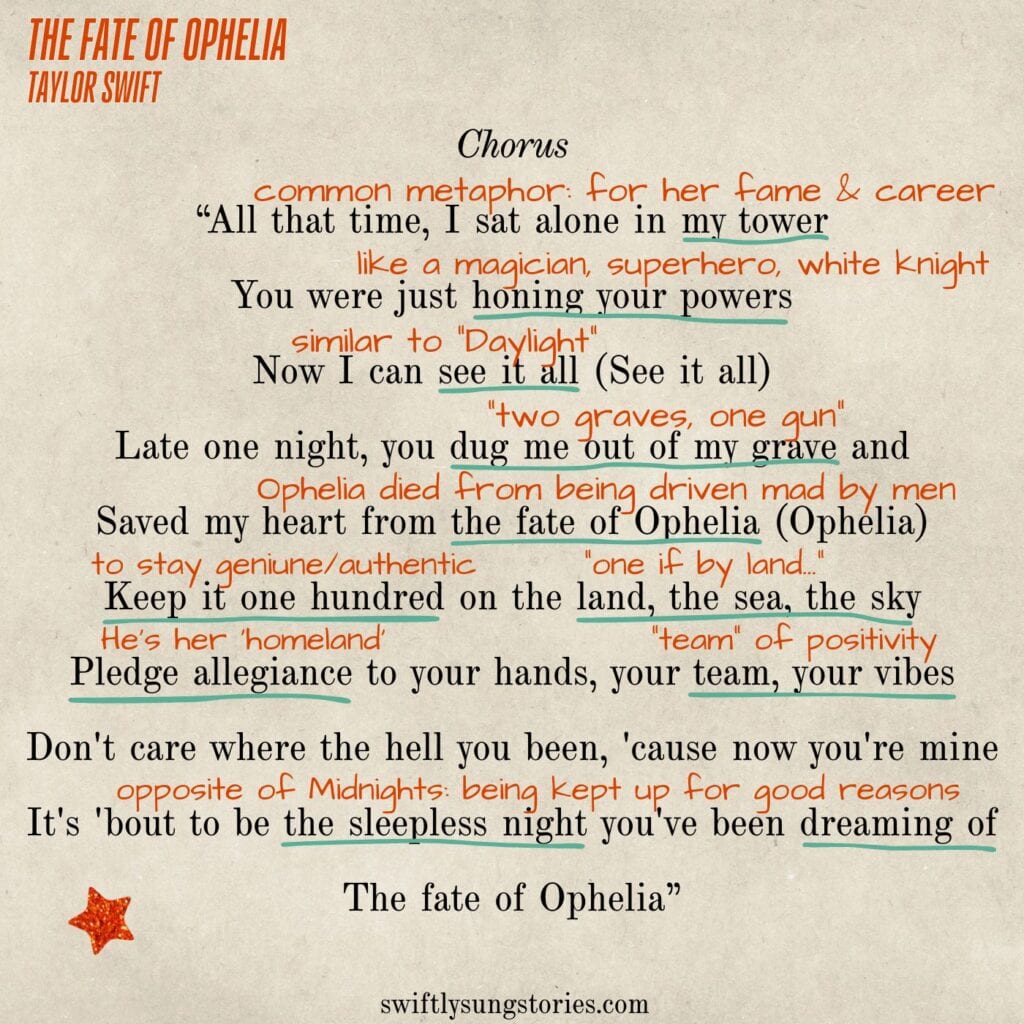
“All that time, I sat alone in my tower,” she says in the first line of the chorus.
The choice of “tower” is a loaded word in Taylor’s universe. She’s often referred to her career and reputation with fairytale metaphors in songs like Long Live, Call it What You Want, The Archer, Castles Crumbling, long story short, Bejeweled, et al.
“Tower” evokes a similar metaphor. It also reminds us of Rapunzel, who is also rescued by a prince. But hasn’t Taylor’s entire lesson about the fairytale ending, as she’s written about in the past (White Horse being the most blatant), is that he’s not coming? That she’ll have to rescue herself?
I think it’s here that we need to contrast The Fate of Ophelia with her earlier Shakespearean song, Love Story. In that track from her much younger Fearless, she re-writes the fates of Romeo & Juliet into a happily ever after. But her version of Juliet in Love Story is more helpless, and more in need of rescue: “Romeo, save me, I’ve been feeling so alone, I keep waiting for you, but you never come.”
In Ophelia, the damsel isn’t exactly in distress. She’s pledged to be okay on her own (“I swore my loyalty to me, myself and I”), but still sees herself as fated to be driven mad by men.
In the play, Ophelia wanders around singing nonsensical (but prophetic) songs, while everyone in court calls her crazy. There’s another parallel between Taylor and Ophelia’s fates: singing only to be labeled the “madwoman”.
But if Love Story says ‘I can’t live without you,’ Ophelia says ‘I can live without you, but I don’t want to, because you’ve broken the curse. I’m no longer the madwoman singing about lost love, because I finally found it.’
While our princess is alone in her hand-crafted “kingdom,” “You were just honing your powers.” He’s not only a white knight, but he’s also a magician, wizard, or superhero of some sort. In the context of the “pyro,” however, this could mean he was honing his powers in the bedroom.
“Now I can see it all (See it all),” she says, finally glimpsing what is possible in life and in love. This recalls a line from Daylight :“And I can still see it all (In my mind), All of you, all of me (intertwined), I once believed love would be (black and white), But it’s golden.” Zooming out and taking in the view, she can see “what the agony had been for”: it was leading her here.
“Late one night, you dug me out of my grave,” she continues, “and saved my heart from the fate of Ophelia.” He’s brought her back to life from death, and the grave metaphor can’t help but remind us of the last time she mentioned one: “two graves, one gun” of So Long, London.
Important to note is that she doesn’t say “you saved me from the fate of Ophelia.” Instead, it’s “you saved my heart from the fate of Ophelia.” Ophelia’s heart is broken by Hamlet. Had this magician not come for her, Taylor surmises, her heart would have stayed in a cold, dead state, not knowing who she could trust.
“Keep it one hundrеd on the land, the sea, thе sky,” she continues, using a popular Kelce catch phrase. To “keep it 100” means to stay authentic and genuine, and she encourages herself to do the same in this new romance, no matter where they are.
Pulling in this modern phrase in a song ostensibly about an Elizabethan character might seem incongruous. But it’s intentional. She’s contrasting our modern times – a modern “showgirl’s” fate – with the fate of an historical Ophelia, who had much less agency to be herself and make her own choices.
“The land, the sea, the sky”, when added to “pyro,” gives us all the elements: earth, air, fire, water. But it also reminds us of the famous “One if by land, and two if by sea,” from Longfellow’s poem Paul Revere’s Ride. This evokes an Americana vibe that will continue in the next line.
“Pledge allegiance to your hands, your team, your vibes,” she says, continuing this all-American verbiage with the pledge of allegiance. She promises loyalty to everything about him, from his body to his “team” (either football team, or his inner circle & family), and his positive vibes. His “vibes” are the optimistic antidote that our Ophelia needed to counteract her melancholy.
“Don’t care where the hell you been, ’cause now you’re mine,” she says, disregarding who he may have been dating before, or why it took him so long to find her.
“It’s ’bout to be the sleepless night you’ve been dreaming of,” she says, trading in the sleepless nights of Midnights and TTPD for a steamier midnight pastime. The rest of the album will be full of similar sexual innuendo, and it’s the most blatantly steamy Taylor has ever been. It’s also the most blatantly optimistic Taylor has ever been.
“The fate of Ophelia” repeats at the end of the chorus, which emphasizes that while she’s re-writing the ending for this tragic character, she’s also re-writing the ending for herself.
Verse 2 & Pre-Chorus 2: “I Hate it Here”

“The eldest daughter of a nobleman,” she begins the second verse, “Ophelia lived in fantasy.” Eldest Daughter is track 5 on the album, but what she’s getting at here is that she has it all. She’s privileged like Ophelia, but while she might have “a fantasy” life, she lives “in fantasy.”
This reminds us of “I hate it here, so I will go to secret gardens in my mind, people need a key to get to, the only one is mine.” Materially she has it all, but emotionally and romantically, she lives in a fantasy world to soothe herself. The key to that world, too, will come back around in the bridge.
“But love was a cold bed full of scorpions,” she continues, “The venom stole her sanity.” This likely alludes to the fable of the scorpion and the frog, where the scorpion gaslights the frog into giving him what he wants, then stings him anyway. That’s what her past loves have felt like.
“The venom” of these past heartbreaks is what’s driven her mad, just like Ophelia. But it’s not only the venom, it’s also the gaslighting; being broken like a promise.
“And if you’d never come for me,” she continues in the pre-chorus, “I might’ve lingered in purgatory.” Colloquially, purgatory is a temporary state of suffering. But in Dante’s Divine Comedy, it’s a middle-ground between life and death, where souls are cleansed of sin. All those sins, Dante posits, arise from love.
“You wrap around me like a chain, a crown, a vine, pulling me into the fire,” she continues, closing out the second pre-chorus. These similes not only describe how he’s wrapped himself around her, but also demonstrate the opposite of Ophelia’s fate.
In Hamlet, Ophelia drowns beneath a willow after she’s woven flowers into garlands (or crowns – different theatrical productions take different interpretations). While picking these flowers, a branch breaks, her dress becomes waterlogged and pulls her down to her death. She drowns amongst the flowers.
But for Taylor’s Ophelia, the natural world works with her, not against her. The branch beneath her doesn’t break, and if it does, her new love has her secured. He’ll wrap around her and pull her into the “fire” (excitement, passion), not the water (longing, dread, depression).
The “vine” also reminds us of ivy (“my house of stone, your ivy grows, and now I’m covered in you”), the chain of Call it What You Want (“I want to wear his initial on a chain ‘round my neck, not because he owns me, but because he really knows me”), and the crown of all her previous monarchy and fairytale metaphors (King of My Heart, The Alchemy, et al).
Bridge: Key to My Heart

The chorus repeats word for word, which is common for Taylor on this album, but not so much on her previous modern albums. Often on Midnights, folklore, TTPD, et al, she’ll change the last two lines of the chorus, or even a few key words here or there. But repetition plays a role, too: it draws our attention to what she’s emphasizing.
Then we reach the bridge: “’Tis locked inside my memory, and only you possess the key.” This is a deeply loaded line with references to both her previous work, and to Hamlet itself.
Hamlet Act 1, Scene 3 is where we find this line, in which Ophelia’s brother is warning her not to trust Hamlet and his promises of love. As they say goodbye, he makes her swear to remember his words of caution.
“LAERTES
Farewell, Ophelia, and remember well
What I have said to you.
OPHELIA
’Tis in my memory locked,
And you yourself shall keep the key of it.”
-Hamlet Act 1, Scene 3, William Shakespeare
Taylor has modernized the phrasing, but kept the “‘tis”. But for Taylor’s Ophelia, it means something quite different. In I Hate it Here, the key represents a secret fantasy world where she finds her happiness amidst the chaos of everyday life.
What’s locked inside her memory is the idea of what would’ve, could’ve, should’ve been, had it not been for his entrance on the scene. But it’s also the sacred nature of what they have: only he has the key to her heart, because he’s been the only one to fully “unlock” her.
Her “secret garden” is now not only hers, it’s theirs, together.
“No longer drowning and deceived,” she continues, “All because you came for me.” This is exactly Ophelia’s fate: to drown in deception, and drown from deception. In so many ways, this “rescuer” is the polar opposite of Hamlet. He’ll “keep it 100”, unlike lovers past who would only gaslight and ghost.
“Locked inside my memory, and only you possess the key” repeats again, reinforcing that there’s a secret place that only the two of them share. ‘Remember how special this is,’ she’s saying to herself, ‘because you’ve known the opposite, and you nearly drowned in melancholy because of it.’
“No longer drowning and deceived, all because you came for me” she repeats at the end of the bridge. Suddenly, when she least expected it, everything has changed.
Final Chorus & Outro: “All This Time”
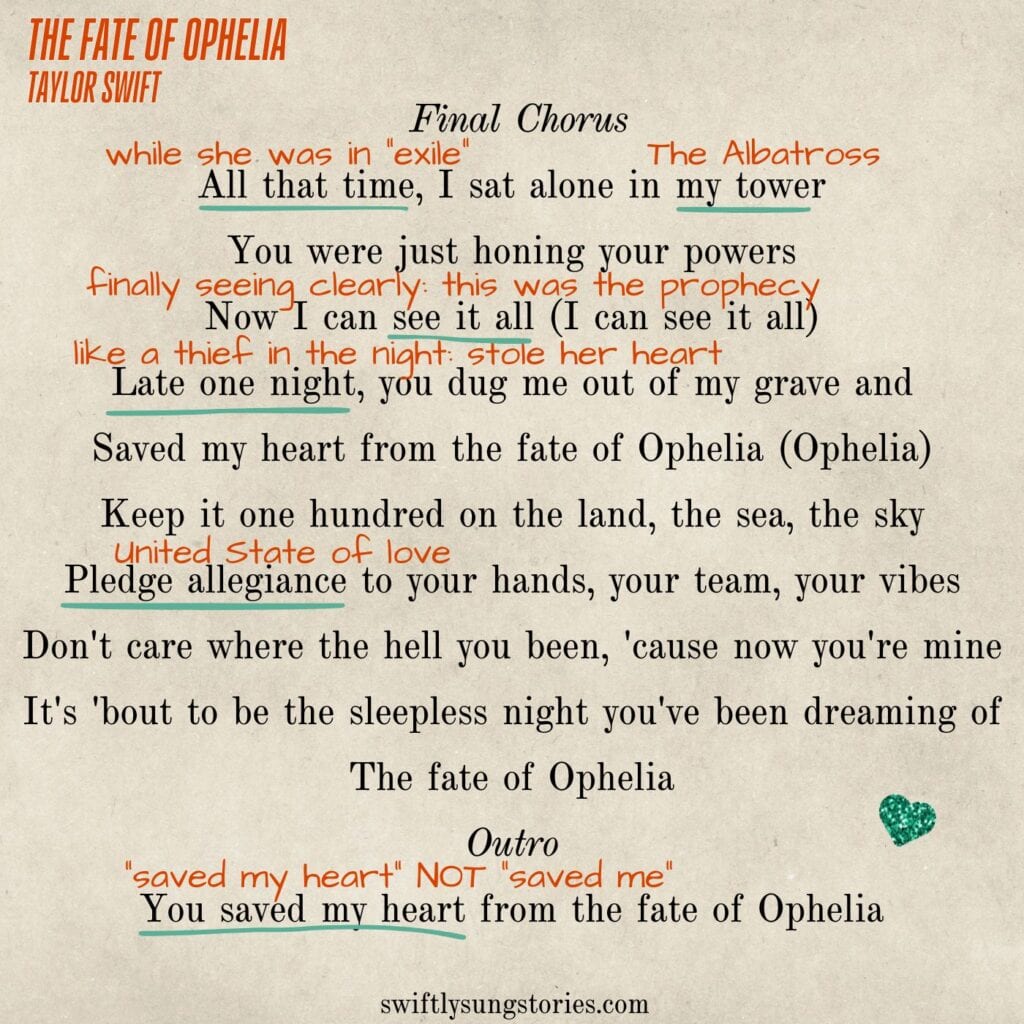
“All that time, I sat alone in my tower,” repeats the first line of the final chorus, and with the repetition, it begins to remind us of another similar line from exile: “All this time, we always walked a very thin line, you didn’t even hear me out, you never gave a warning sign.”
That incredible track from folklore is a conversation between two ex-lovers who are in a stalemate, and will never understand one another. “All that time” with other people, who would only eventually leave her to the fate of Ophelia, this magical love was right around the corner.
But “time, curious time, gave me no compasses, gave me no signs…” They say you’ll find love when you stop looking for it. Maybe once you actually listen to your brother Laertes, and trust that you can’t trust everyone in love, you’ll finally learn the lesson that will lead you out of the water and into the fire.
The rest of the chorus repeats, with only the outro varying from the rest: “You saved my heart from the fate of Ophelia.” Repetition is used to bring attention to central themes and messages, and here it’s “heart” that’s the most noticeable.
Physically, would she have succumbed to the “fate of Ophelia”? No. But would her heart have metaphorically died of madness, after letdown after letdown, promises broken, castles crumbled, and “jokers dressing up as kings”? Maybe.
But that’s all in the past, because no matter what happens with this new love, she finally believes in it again. She can “see it all” – what’s possible, what’s right for her, and what a real partner feels like.
On the cover of the album, she’s head-barely-above-water in a bathtub, in full showgirl garb. But she won’t drown there, and though the trappings of the showgirl life are heavy like Ophelia’s gown, she now knows that she doesn’t have to succumb to the melancholy.
More from The Life of a Showgirl


